Saturday, October 16, 2010

Bienvenidos a Loreto!

Living Loreto begins again!

I am very happy to welcome you back to my version of life in a special place – Loreto, Baja Sur, Mexico. After spending four months over the past summer visiting with friends and family back in Canada, I was looking forward to returning “home”, here in the Loreto Bay development, 15 km. south of the town of Loreto.

This return marks the beginning of my fourth winter Living Loreto and the third year of writing this Blog, for which, your ongoing support leaves me humbly grateful. Although I have met some of you, my readers, many more remain anonymous, but no less a real presence, bringing with you a sense of obligation. For those of you who have ventured to the very bottom of this page, you will know that I have received over 35,000 hits since starting the Blog two years ago. This is a number that I have trouble grasping, but one that I take some considerable pride in.

But with that pride there comes the sense of obligation, my commitment to putting into words the thoughts, impressions and day to day experiences that make up my life here. What I have come to realize is that by setting myself this challenge of putting down in words something relevant to my life here, I am able to view and experience things in a more involved and present way. No less than Socrates said it best; “An unexamined life is not worth living” (imagine the Blog he would have written!). So for that, I thank you - even though, I frequently feel some anxiety as the weekend approaches and it’s time to sit down and produce the next instalment.

But that is followed by the sense of relief and satisfaction that I feel when I hit the “publish” button and send these thoughts into the ether, where you can click on them, add your presence to the growing total of readers from week to week, and by so doing set up the whole process for another week. So we have a symbiotic relationship, by you coming back week after week to read these thoughts you create the obligation for me to continue to write things down and publish them. To the extent that you get some benefit from reading this, you provide me with an enhanced life experience by the act of writing about it. In fact, often I find myself looking for situations or experiences that would make a good Blog and so you become my motivation for doing things I might not have done otherwise, to have material for the next instalment.

Enough navel gazing for one piece – now to bring you up to date with my recent
return trip and first impressions as I am settling in again. I made the return drive from Calgary Alberta (north of the Montana border) in 4 days, covering just less than 4,000 km. On this trip I was accompanied by a fellow Homeowner in Loreto Bay, Grant, who wanted to experience the drive with me, in preparation for his own first trip down by vehicle next spring. Having a companion on the trip made it much more enjoyable and the time passed much faster with company – although, I’m afraid I may have tested Grant’s patience with my long rambling stories.


The border crossing into the US went smooth and easy – Grant claimed it was the positive influence that his presence added – but after my previous experience a year ago I was grateful for an uneventful passage. We continued on I-15 south through most of Montana on that first day, enjoying some of the most beautiful scenery of the entire trip, before stopping for the first night in Dillon, a small town just over 900 Km south of Calgary which was our goal distance each day.

Since this has been a regular stopping spot for me for the six or eight round trips
I have made to Loreto over the past 5 years, I did not anticipate any need for reservations until we pulled up to my regular Motel and were told they were fully booked due to the local Rodeo happening that weekend. After trying several other places in town, with the same results, we were heading back to the highway and looking at another 40 miles or so to the next town when we stopped at the last option – the Creston Motel, an older “auto-court” style operation (think Bates Motel from Psycho with a fresh coat of paint). There, we were pleasantly surprised (and a little worried) to find that they DID have rooms available – I later concluded that their location in the center of town, far from the highway, was the reason for their vacancies, and not any more ominous issues. In fact, the rooms were newly, if less than professionally, renovated, and after my initial concerns I came to appreciate their individuality after the sterile “cookie-cutter” accommodations that have become the norm along most major highways. An added feature was that this Motel was a short walk from my favourite restaurant in Dillon (confession, the only restaurant there I have eaten at) Sparky’s Garage Diner where we had excellent plates of ribs and pulled pork with the sweetest corn bread I have ever tasted.

The next day took us through Idaho, past the Great Salt Lake and into Utah where we stopped just north of the Nevada border in St. George a thriving retirement based community with emerald green golf courses in the middle of red sand desert surrounded by pristine residential developments and big box malls, many of which have sprouted during the five years I have been travelling this route. I’ll blame road construction (again!) for missing my normal exit for my regular Motel stop here, which caused Grant, who was driving at the time, to have to double back and re-
approach from the south. This resulted in our staying at a beautiful new Fairfield by Marriot high-rise Hotel with a Players Sports Bar and Grill next door – perfect for the steaks we had promised ourselves for that evening’s dinner. Our last night in the States was spent in brand name luxury surrounded by all the sparkling new amenities that the pre-boomer retirees could want for, with a year-round summer climate.

I had warned Grant that day three would be our longest, leaving St. George by 8:30
we were soon passing through one of the scenic highlights of the trip; the Virgin River Gorge, where the 4 lane divided highway curves it’s way through spectacular rock walled gorges for several miles of what must be the most expensive stretch of
highway on the entire trip. About an hour later, after covering miles of non-descript desert, we approached one of the man-made wonders of this part of the world – Las Vegas. Passing through this metropolis of money, surrounded by iconic architecture, 24 hour sex shops, and shooting ranges, creates a sensory overload after the previous few days of travelling in some of the most barren landscape in the west.

Leaving Las Vegas – no pun intended – we began the long climb through the pass to
Baker CA, where we stopped at The Mad Greek, where we had great Calamari and Greek salads before we carried on for the decent into the great State of California – again, no pun. Before reaching San Bernardino we entered the extended megalopolis that continues from central California all the way south to the Mexican border. Because Grant needed a FMM Tourist Visa we chose the Declaration and Documentation lane at the Tijuana crossing, parking in the Customs lot just across the border line.

After getting the visa at the Immigration Office, paying for it at the nearby Bank window, and returning to Immigration with the receipt and receiving numerous rubber stamps in the process we were done. This was also the first time I had entered Mexico with my new FM3 ID card, replacing the 4 year old, somewhat worse for wear, visa booklet I had previously carried. So it was with interest I saw the Immigration Officer give my laminated card a quick glance, comparing it to my Passport, and then returning it to me with a smile – no rubber stamps, and with no computer scan or record of my arrival – Quien sabe!

We returned to the car in the parking lot that was crowded with more than a dozen vehicles, many of them small trucks with assorted cargo, that were being attended to by half a dozen Customs Agents, inspecting their loads and completing forms on clipboards. I drove through this scene of organized confusion slowly and carefully, avoiding eye contact with anyone in uniform, until I reached the exit with the ubiquitous red/green light that determines who gets a more thorough inspection. Seeing that nobody was paying any attention to these two Gringos in the SUV, everyone being occupied with the everyday business of crossing the busiest international border in the world, we emerged from the Customs area and carefully merged with the chaotic 6 lanes of “nothing to declare” traffic heading south.

A couple of quick turns later (more detailed driving instructions are in my earlier
postings) we were on the “Scenic Toll Road” heading to Ensenada and few grim miles of Tijuana tenements later, we drove along the shoreline past a collection of oceanfront resorts, some occupied and others abandoned before completion, telling a too familiar story of Real Estate development in Mexico. As our distance from Tijuana increased, the tension and apprehension I had felt crossing the border diminished, until we were approaching the port city of Ensenada about 100 km south.


Because of the time and fading light, we decided to forgo the temptations of a shopping stop at Costco and pressed on to our destination of San Quintin, another 250 km further south. This proved to be a wise decision, because half an hour south of Ensenada we were diverted onto the longest detour I have experienced in my five years of driving the Baja. Did I mention that it was now raining? So for 45 minutes, from dusk to dark, we crawled along a greasy, muddy ploughed track through the dirt, beside what will be a new stretch of divided asphalt highway – some day!

By the time we finished the detour it was darker than I would normally like to drive on Mexican highways, but with nothing much before San Quintin ahead, and the prospect of the detour behind us, we carried on in some of the heaviest traffic we would see during the entire trip. The advantage of driving after dark in Mexico with lots of other cars, is that you can be pretty sure that the road ahead is clear of cattle and other unexpected events. The disadvantages include all the normal hazards of narrow road, no shoulders, poor markings and unexpected “Topes” or speed bumps that are compounded by the darkness – plus the added adventure of the possibility of oncoming vehicles, without headlights!

This was not Grant’s baptism into Mexican highway driving – he has rented cars and
driven as far as Cabo, 6 hours south of Loreto. But he confessed later, over several much needed pre-dinner beers, that the NASCAR element of passing tractor trailer units in the dark, on a rainy night, given all the previously mentioned factors, was a new experience, and one that he was not anxious to repeat. Needless to say, we arrived safely, if somewhat rattled, at The Villa San Quintin by 9:00 pm that night, over 12 hours since we left St. George, travelling over 1,000 km – and much further culturally, and we were both euphoric and finally being in Mexico after three straight days of driving.

The final day took us into the central peninsula, through the granite field around
Catavina and then back out to the Pacific coast to Guerro Negro, where we stopped for a very civilized lunch at Mallarimo, a landmark restaurant/motel I have stopped at often before. From there we crossed the peninsula, finally descending La Cuestra del Infierno (Hill from Hell) into Santa Rosalia on the eastern coast and the beautiful Sea of Cortez. Thus began our final leg, south to Mulege, on past Bahia Conception with it’s fantastic turquoise blue water and many white sand beaches and finally across the long plateau that ends as we drop down into the Loreto area, guarded on the west by the Sierra Gigante mountains and fronting on the Sea of Cortez. As the sun set on our final day of travel it highlighted the offshore islands of Coronado and Carmen and we both knew we were Home!

To travel most of the length of North America in four days, pass through some of the most beautiful, and at times, most desolate scenery, skirt huge metropolitan areas, and bypass dusty Mexican hamlets that have been unchanged in 30+ years, to arrive in gratefully familiar surroundings and feel a true sense of belonging, of being Home – THAT is what Living Loreto is really about! Bienvenidos and Welcome back!

Sunday, June 6, 2010

Thoughts from the Road

Well, here I am, back in Canada, after a long, but largely uneventful drive last week. From Loreto I travelled to San Quintin, about 850 km north the first day. On Monday I continued through Ensenada, where I left the main highway, and took Mexico #3 northwest to Tecate, crossing the border into California about 1:30, after a half hour wait. Backtracking west to the Interstate corridor, I continued north on I-15, stopping mid-afternoon in Temecula for a shorter day of just under 500 km. From there, Tuesday morning, I proceeded through San Bernardino and into Nevada, past Las Vegas, clipping the corner of Arizona before entering Utah, where I stopped after 800 km in a town called Beaver. Wednesday was the longest of the trip, after passing through Salt Lake I was close to the border with Idaho when I took the wrong lane in a construction zone and wound up on different highway heading northwest.

Unfortunately, I didn’t notice my mistake for some time, as it was a remote stretch with no intersections or towns. By the time I rejoined I-15 my detour had added over 150 miles and over two hours to my day, which finally ended after 12 hours and 1200 km in Dillon Montana. Thursday morning I covered the 550 km to Canada, crossed the border just after noon, and finally arrived in Calgary about 4:00 pm for a total trip of just under 4,200 km.

Travelling thousands of kilometres over several days is a unique opportunity to collect one’s thoughts, while being in a sort of limbo between origin and destination. One general observation from the trip north through the Baja, is that while I have often written about how much I love different aspects of living in the area around Loreto, and particularly in the Loreto Bay development, I have to admit that I don’t “love” very much about the rest of the Baja between there and the US border. There – I’ve said it! – “The Emperor has no clothes”! I feel vaguely guilty making this sort of uncharacteristically negative statement – but honesty compels me to do so.

The fact of the matter is, Mexico is a poor country, particularly in the non-tourist areas of the Baja, and the poverty results is poor living conditions, roads and other infrastructure. The many towns and villages along Mexico #1 all appear quite similar, a string of small untidy shops on the dusty margins of the highway, gas stations, taco stands, dogs, kids, trucks and busses. There is little to entice me to stop for anything except periodic fuel on the 1,000+ km trip from Loreto to the Border. I carry a 12 volt cooler with plenty of water and some road snacks, so I don’t have to stop for food, other than when I make my overnight stop, unless I choose to break the trip at one of several familiar restaurants. I also try to avoid making the other sort of “rest stops” if possible (the condition of public restrooms on the highway are challenging to say the least) this is one more reason why “I enjoy being a Boy!”.

I also feel uneasy travelling through parts of the peninsula. The periodic vehicle inspection stops (there are currently six of them between Loreto and the US Border, via the Tecate crossing) manned by heavily armed Federal troops are a source of some stress and uncertainty. Although, I must say that I have never had a bad experience in the many times that I have passed through these inspections over the half dozen round trips I have made through the Baja, but I still feel somewhat intimidated every time I approach one of these stops. If nothing else, they serve as a reminder of the current situation with the so-called “war on drugs” that receives so much negative publicity north of the border.

Perhaps I am naive, but I think that much of the hysteria surrounding this situation is unwarranted. While obviously there is a serious problem in some parts of Mexico, with billions of dollars of illegal trade in drugs and guns and the huge toll in human lives and suffering that is the collateral damage of this business. But, in my opinion, these inspections probably yield a tiny percentage of the huge traffic they are apparently intended to intercept, although, there are large photographs displayed at some of the stops, showing stacks of bricks of seized dope and the poor unfortunates who were apprehended. I think that this very visible presence is there to act more as a deterrent than to actually seize and destroy the drugs they are looking for.

In defence of my position, is the very nature of the inspection process itself. In practically every stop I have been through, I can count on the Inspector to: a) look under the driver’s seat, b) look in the center console between the front seats, c) rummage around in the various papers and maps that litter the front seats of the car. It is a rare occasion that any of the other boxes or suitcases that I am usually travelling with are ever opened or inspected, and, if so, it is only ever those things that are most easily accessible and never a box or bag buried underneath that would require even a little more time and effort to look into. This apparently half hearted effort to inspect leads me to the conclusion that this whole process is a bit of a charade, all be it, one in which one of the participants is carrying a loaded assault weapon!

(There are of course the exceptions – like the last stop on this trip, just south of Tecate and the border, where a young 20 year old soldier did actually open my overnight bag and the toiletry kit inside, from which he removed the two travel sized bottles of shampoo and conditioner and looked at me quizzically, I gestured at my hair and said “shampoo” to which he nodded solemnly and replaced everything. At last, America would be free from greasy hair, perhaps the billion dollars of US subsidy through the DEA that funds these inspections all over Mexico was now justified!)

A further observation I made on this trip is, that one of the biggest factors negatively affecting my state of mind while I am travelling, is the fact that I don’t speak the language. Of course, this inability to communicate, in any but the most limited manner, is also a fact of my life day to day in Loreto. But I have learned to manage well enough there by limiting my exposure to situations where anything more than a few words and appropriate gestures will suffice.

I have expressed regret and some guilt over this shortcoming of mine several times in this blog over the past winter. However, I have decided that since I have now committed to spending my foreseeable future “Living Loreto” (and, not insignificantly, “Working Loreto”) it is obvious that I must begin again the process of learning Spanish. Now, I don’t make that statement lightly. I have never had an “ear” for language – my unfortunate experiences in school over 40 years ago with first French, and then out of desperation (or perhaps worse) Latin – has set an unhappy precedent.

However, after procrastinating all winter, I am hereby publicly committing to a new resolution – I am going to work on the Rosetta Stone language program while I am away from Loreto this summer. My goal is, that on my return in the Fall, I will have at least a modest grasp of the basics of the language so that, as I continue to study, I will be able to begin to communicate with more confidence in my day to day activities. It is abundantly clear that acquiring a basic facility with Spanish is minimum requirement for me to have any right to claim Loreto in particular, and Mexico in general, as my adopted home for the future. Therefore, I am choosing this public forum to make a commitment, and I will report back to you all, at the end of the summer when I resume my writings here, the progress I have made in meeting this challenge!

Now, in conclusion, I would like to express my sincere appreciation to all of you who have read these pages over the past two winters. The Blog process is a fascinating one, and rewarding in unlikely ways. Although I have had the opportunity to meet a few of you, the vast majority I never will, but your invisible presence every week is all the incentive I need to sit down and put my thoughts and observations down and share the images that often are a large part of my experiences. By so doing, I have benefitted from this record of most of two years of my life, as someone once said: “An unexamined life is not worth living.” By coming back, week after week, and reading these thoughts, you have given me that gift, and for that I am grateful!

I can only speculate what this process has brought to you, but it is my sincere wish that is has been sufficient to bring you back for more in the Fall so that we may continue this adventure together, and with that thought, I leave you with my final quotation for this season: “Without no audience, there ain’t no show!” Be well, have a safe and happy summer wherever you are, and we have a date to get back together here to do it all over again next winter – and that really is what “Living Loreto” is all about!

(Not being a geek by nature, I am not the best authority for this, but, I believe you can flag this site with a RSS feed notification so that you will be advised when I start posting again – but, my plan is to start writing when I return to Loreto sometime in late September or early October. When I start posting again, I will advise the members of Club Loreto Bay (a private Homeowners site) and Lynn Hamman’s Loreto Community site: Loreto_Community@yahoogroups.com ‘till then, Hasta la Vista!)

Sunday, May 23, 2010

Fishing Tales

Considering the location of the subject of this week’s posting, regular readers of this Blog could reasonably wonder if the name should be changed to “Living Punta Nopolo”, because, for the second week in a row, that is where my story takes place.

But this week I am not just climbing up and walking around this landmark of Loreto Bay, this week I am writing about a recent morning I spent fishing off the rocks surrounding it’s base. But before I go any further, let me be clear that I do not consider myself to be any sort of experienced fisherman – far from it! I did do some fishing (but very little catching) on a mountain lake where my family had a cabin when I was growing up. In the intervening years before coming to Loreto, I had only a few opportunities to fish, with about the same results as I had in my youth, but shortly after I took possession of the house here I had a very untypical experience. One of our early visitors was an avid fisherman and so I chartered a boat during his visit and we went out for a day’s fishing with a captain. After spending most of our chartered time without a nibble, the captain finally asked us if we wanted to try for Sailfish? Needless to say, we said Yes!, and so off we headed to a new location several miles away. As the boat started to slow down, signalling our imminent arrival, we could all of a sudden see in the distance silver flashes dancing above the surface of the water. As we drew closer those flashes became jumping fish, man sized or better, we had found our prey!

Since this wasn’t what I was planning to write about I’ll wrap up my fish story in brief – suffice to say that both my buddy and I “hooked up” within five minutes of our baited hooks hitting the water and although the real fisherman wound up losing his catch while trying to board it on the boat, beginner’s luck was with me and after a 20 minute struggle fighting the fish back to the boat, after it ran out several hundred yards, I managed, with lots of help from the captain, to land (boat?) an 8 or 10 foot specimen!

With that spectacular exception, and some outings on a friend’s panga which yielded a few modest catches, most of my fishing experiences have been solitary expeditions to the rocky shelf of Punta Nopolo at low tide where I can cast out into the deeper water. While I enjoy eating fresh fish occasionally I am not motivated by what I might catch, which is a good thing given my very modest results from these outings.

Rather, the attraction for me is spending a few hours on the shore enjoying the water and watching the colourful small fish that live in and around the rocks. It’s a great excuse for doing very little but enjoying some time on my own, close to the water, and feeling justified by the occupation of “fishing” as the excuse for doing that very little.

As I described in last week’s posting, the low tide shelf provides some excellent locations around the base of Punta Nopolo to get access to the deeper water and so co-ordinating with the tide is an important consideration. Years ago, when I was learning to sail, I was introduced to tide tables in the form of phone book sized volumes covering large areas of shoreline with predictions as to the time and variation of the high and low tides for a particular location. Now, through the magic of the internet, that information, specifically for the Loreto area, is just a few clicks away so the night before I checked the data and found that low tide the following morning would be at 8:30 – perfect!

I assembled my equipment, rod and reel, the tackle box with a collection of lures and the other accessories like a knife and pliers (for removing hooks), and a pail to carry the net to keep any catch unlucky enough to become my victim, as well as a “fish bonker”, my ultimate weapon if all else fails. To this I added my cameras and a tripod (so I can include some of these “action shots” of my limited casting technique) and a thermos of coffee and some bottled water – no one has ever accused me of traveling light! Loaded down with all my “necessary” equipment I headed out about 9:00 am for the beach and the familiar 15 minute walk down to the point.

Often when I am walking on the beach I meet other Homeowners and exchange greetings or other small talk, but when I am carrying my fishing equipment, I assume the role of “Fisherman”, and this usually elicits some comments or questions that make the assumption that I have some expertise in this area. Hahhh! On these occasions I usually adopt a suitably modest attitude (one that they may mistakenly take as self-deprecating) and I often make some comment about measuring success by the number of lures I don’t lose, rather than by the number of fish I catch.

As I make my way around the wide shelf of rock exposed by the low tide toward my first casting perch, I recall that I had left out an observation from my last posting which I want to include here. In the conglomerate rock that makes up the base of the point there are dozens and dozens of “potholes” where apparently softer material has been eroded away leaving cavities that range from a few inches across to several feet. Most of these hold water, left behind from the last tide cycle, and almost all of those have some sort of life swimming around in them, sometimes with underwater plants scaled to these micro-environments.

As I walk across these rocks I see the tiny “tadpoles” (for lack of a more accurate
description) flitting around in their own little universe, with sometimes a dozen or more creatures in these natural aquariums. And I wonder what happens twice a day, as the tide turns and the water level inevitably rises, and then these sheltered little habitats are submerged becoming part of the sea floor again. Somehow these tiny creatures manage to survive the sometimes crashing wave action and the larger predators that come with the rising water until they are once again “stranded” in their safe-again refuge until the cycle repeats itself, day after day, in a cycle as old as these rocks themselves. Now that is a challenging life cycle!

Anyway, I am here for bigger fish, not necessarily to fry, and so I take my position on a favourite outcrop and proceed to begin the ritual of selecting the first lure of the day and starting to cast out into the gentle water surrounding me. Most of the shoreline here in this deeper water is populated with beautifully colourful schools of what I would describe as “tropical” fish, like you can find in home aquariums, most of them a few inches long and exotically coloured in yellows, blues and other fluorescent shades. As I retrieve my lure and it passes through these fish they are immediately attracted and follow the “intruder” until it magically leaps out of the water and disappears, only to return again a few minutes later when the process repeats itself.

I find myself imagining the startling effect this event could be having on the normal routine of these fish. Although they are more spectacular and exotic to my eyes than the lures I am using, I can’t help wondering if, in this homogeneous society of apparently identical creatures who spend day in and day out swimming around, seemingly of one mind, and then, out of the blue (literally!) comes this “Lady Gaga” individual with flashing spinners, sparkly painted finish, not to mention trailing a cluster of hooks in it’s wake! Considering the predictability of their normal routine, I can’t help but imagine this stranger’s visit marks a red letter day for these fish – or maybe I’ve just been standing in the sun too long!

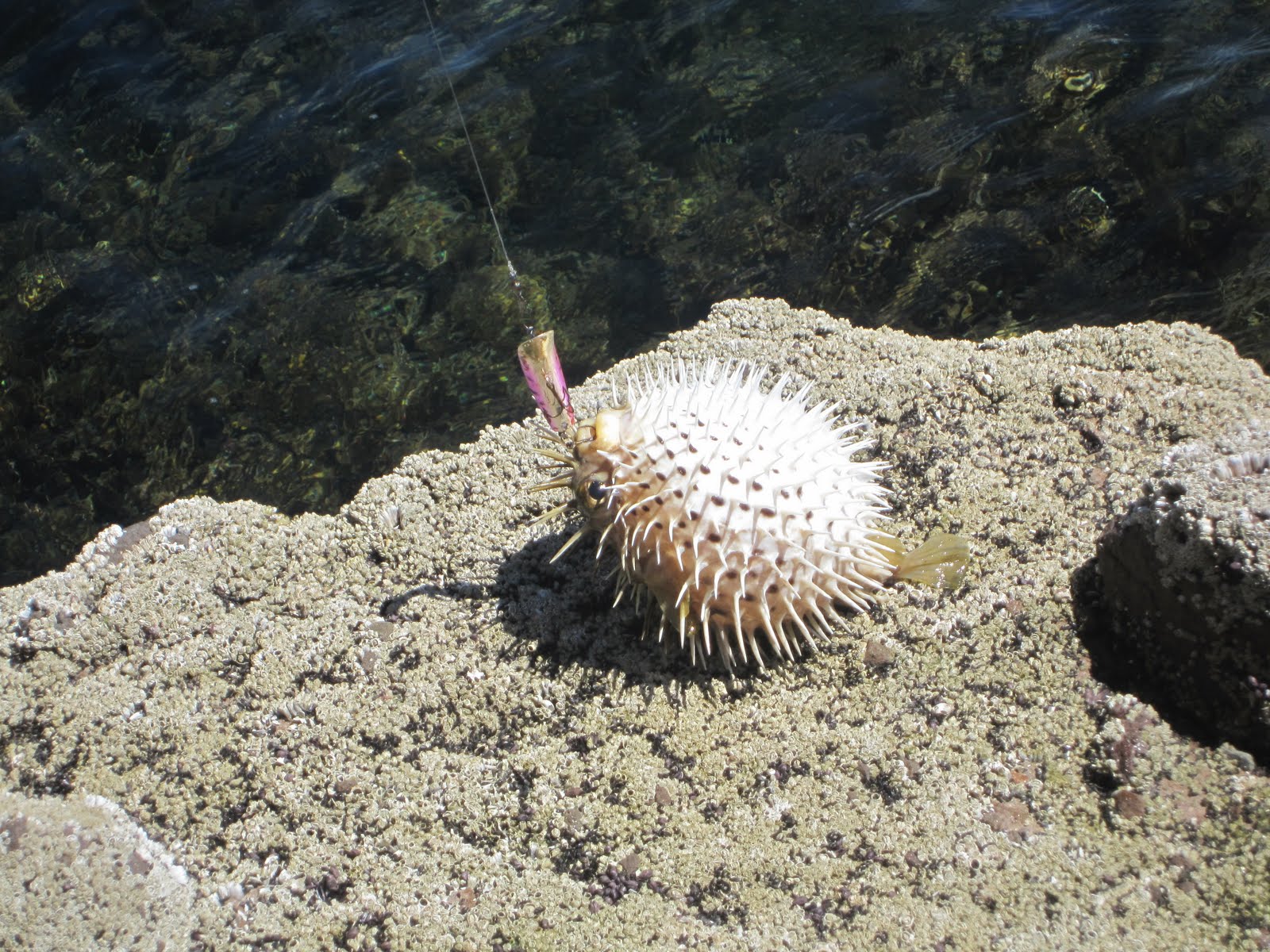
And so it goes, trying different lures, occasionally seeing something bigger than the lure itself following it into shore, watching the water pulse in and out around the rocks I am standing on, and, eventually moving on to the next spot further on, that I have convinced myself is even more likely than where I have been. This trip however, was punctuated by an unusual event – I actually caught something! While so called “Puffer Fish” are generally considered a trash fish by most people, I find them more interesting than most of the fish that are more highly prized for their edibility or sport.

I think the first time I had seen one of these creatures (complete with a coloured light shining inside) it was hanging over the bar in the basement of the home of a girlfriend of mine back in high school. At that time I don’t think I realized that this kitsch souvenir of some trip to Hawaii in the ‘sixties, was in it’s “inflated” state and it didn’t spend it’s whole life in the shape of a balloon studded with dozens of nasty spikes. So when I caught this bug-eyed specimen and landed it to remove my lure, I observed this amazing defence mechanism begin, as it started panting on the rock, (appropriately in much the same rhythm as we would use to blow up a balloon) and then I watched as it “blew itself up” into a half-sized soccer ball causing it’s spiky horns to protrude all over it’s skin. Then, holding it’s breath, it appeared to observe me, somewhat balefully, with it’s now even more “buggy” eyes, as if to say: “Are you scared yet?”. It held this threatening pose for less than a minute, then, through a series of rather moist farting sounds (sorry, you had to be there) my catch gradually deflated and lay there until I did something else to alarm it and cause this exotic strategy to begin all over again.

Before the SPCA shuts down my blogsite I should assure you, my fainthearted readers, that after retrieving my lure (with no more damage to the fish than a cut lip) I returned this specimen to the sea and it swam off, I would like to think, relatively unperturbed to continue doing whatever it had been doing before it had been so rudely interrupted by my apparently irresistible (at least to one Puffer) lure. I couldn’t help respecting the fact that this lowly “trash” fish had developed one of the most bizarre and effective defence mechanisms of any similar sized fish in these waters. Puffer’s may be considered “trash” by sport fishermen, but I am sure that this species is seldom bothered by any of the larger and otherwise threatening denizens of the deep!

I continued my way around the point, trying different spots along the shore, until early afternoon when I decided to head back home, but before I left Punta Nopolo, I climbed up on the elevated tee box of 15th green where I took this picture. I realized, during a recent golf game, when I was teeing off from this spot, that this was a view that should have been included in last week’s piece about my climb - so I have included it here.

Photo assignment completed, I made my way back along the shoreline to my end of the Founder’s Village and returned home after spending a peaceful morning exploring the natural beauty and wonders that exist here, where the land meets the Sea, where the mountains come to swim, and although I have said it before, this really is one of the best parts of “Living Loreto”.

(Editor’s Note: Because I am leaving to return to Canada next weekend I may not have time to write another Blog from here before I hit the road. But please check back, as I will write, if my packing up is under control and I have the time. Regardless, I will post a final instalment when I return to Canada, probably wrapping up my northbound trip.)

Sunday, May 16, 2010

Above and Below - Punta Nopolo

The title photo above is of Punta Nopolo at dawn. This rocky point that gives it’s name to the surrounding area of Nopolo, and marks the south end of the Loreto Bay development, is in front of the beach at the Inn at Loreto Bay.

As the time for my departure from Loreto draws nearer (I am planning to return to Canada at the end of this month) and the demands on my time selling Real Estate here has dropped off, with the reduced numbers of visitors at this time of year, I am making an effort to do some of the things that I haven’t made time for during the past winter.

On one of my now more frequent walks on the beach this week, I decided to climb to the top of this landmark and enjoy the view. Approaching from the beach I crossed over the picturesque 15th green of the golf course and found the access point for the beginning of the climb and began the scramble up. Making my way up the dry rocky slope brought home to me what the natural desert terrain is normally like here. Surrounded by lush plantings in the community courtyards, that are scattered throughout the development, and living in my home with irrigated gardens, one looses touch with the fact that we live in an otherwise harsh desert climate here.

In spite of the fact that this rocky promontory is bone dry – it’s been months since we’ve had even the lightest precipitation, and we are at the beginning of the hottest and driest months of the year – remarkably there is plant life, if not flourishing, but surviving. The hillside is made up of sand, gravel and rocks, with solid outcrops of apparently volcanic boulders, leaving a record of the tumultuous events eons ago that created this dramatically beautiful, arid landscape.

As I reach the halfway point I pause in my climb and turn to appreciate the breathtaking view of Loreto Bay and the Inn and Golf Course that stretch out below me. The green velvet of the fairways wrapping around the estuaries are surrounded by the rugged Sierra Gigante Mountains, providing a dramatic contrast between man-made and natural terrain.

Below me, at the base of this hill, begins the beach in front of the Inn at Loreto Bay, washed by the usually gentle, warm water of the Sea of Cortez. From this distance the hotel property looks pristine, but abandoned, as it awaits the guests that will return when full operations resume. Given the beautiful location on this sheltered bay, it is believable to me that the day will come soon, when this property will be busy with the activity and life of vacationers falling in love with this special place.

About two thirds of the way up the slope, I reach the first view over the other side towards the ocean, where the rock cliff drops 150 feet straight down into the deep blue water. The sea side of Punta Nopolo has been carved almost vertical by wind and water over millennia. This sculpted rock stands as testament to the powerful forces that can be unleashed during those occasions when this now placid body of water can be whipped into frenzy by extreme weather and lash the shore.

The last third of the climb becomes much steeper and is composed of solid rock outcrops with almost no vegetation. As the going gets tougher I become more conscious of my “dislike” of heights, and I pay closer attention to my hand and footholds – now would not be a good time to slip, slide away! When I reach the pinnacle of the climb there is the first of two surprises, a tiny shrine carved into a small cave-like crevice in the rocks, protected by a loose web of cords protecting a candle in a glass and a small picture of the Virgin Mary. I pause at this primitive, but sombre memorial for a moment and my first uncomfortable reaction is gradually replaced by an appreciation of the effort and devotion that someone has had to create this remembrance of a loved one.

A little further up I find another unexpected addition to the peak, a hand-made ceramic plaque inscribed with the words:” Loreto endless beauty shared with the world” and a date 06/28/08 – I couldn’t have said it better myself! This plaque is further decorated with a starfish studded with pearls – perhaps in recognition of the bounty that comes from the living waters stretched out far below. Here I pause again and contemplate who might have been responsible for this little piece of human creativity, paying homage to the breathtaking beauty of the surroundings. I think I’d like to meet that person – on second thought - I hope I already do know them, among my friends and Homeowners in the community below.


Another 10 or 15 feet further up I reach the top and, in spite of my growing anxiety over the height (I was now over 200 feet above the shoreline below) my fear was replaced with awe over the view that stretched as far as my eyes could see in all directions. Across the calm, deep blue water there was Ilsa Carmen framing the horizon to the east, Danzante to the south, merging into the rugged cliffs stretching beyond my position on this point. The manicured grass of the fairways, divided by the estuary rimmed with mangrove, wraps around the hundreds of pastel coloured homes making up the village that stretches along the gently curving shore. To the west and north the jagged peaks of the Sierra Gigante range make a dramatic backdrop to this breathtaking view – and I crouch from my perch atop Punta Nopolo, speechless at the beauty that lies before me!

After enjoying this reverie, I carefully retrace my way down to the base again and then I begin to circle the shoreline that has been exposed by the low tide. Around most of the perimeter of Punta Nopolo extends in a solid rock shelf at the low water mark, presumably created by eons of wave action. This remarkably flat surface is broken by occasional boulders that are composed of harder material and have withstood the erosion that has shaped the shore here.

Large rocks make stepping stones into the now gentle water and create some wonderful spots for angling into the deeper water a short cast further out. While I am standing there I hear and see a splash in the water, followed a short time later by several others. While I reach for my camera I see first one, then several, and finally more than half a dozen, foot long blue hued fish jumping in unison and travelling 15 or 20 feet through the air before splashing back into the emerald green water. After they have disappeared I marvel at the energy that must have been required by them to swim fast enough to breach the surface and then launch out of the water and fly that far. I can’t help wondering if this brief aerial exhibition is the equivalent for them to what a quick plunge into the ocean is for us?


On the east side of the point, which is exposed to the full force of the occasional
storms, the cliff is almost vertical with undercut areas near the base. Seabirds have favourite perches, painted white with guano, from which they primp and preen, or just rest and observe their surroundings. About three quarters of the way around the base there is a tumble of huge boulders that require scrambling across and over to reach the quiet south side. Here there is another flat shelf of rock that divides into more stepping stone boulders just above the surface of the water and the cliff is undercut even deeper by the waves at high tide.

This is also the entrance to the estuary that I had observed from above, with a breakwater of big rocks stretching half way across, to protect the calm water and mangroves beyond. I make my way to where these rocks meet the edge of the hill and soon am back on the grass surrounding the green where my exploration began. Looking back up to the crest of the hill I recall the views from there and then the solid rock shoreline surrounding this point of land and I think how appropriate the local saying is, that describes this area: “Where the mountains come to swim”.

Taking the time on a perfect day to re-explore and appreciate again the natural beauty that surrounds us here - but that we too often take for granted – that is another special moment I will remember about “Living Loreto”.

Saturday, May 8, 2010

Home, Sweet Homex?

All of you who are Loreto Bay Homeowners are well aware of the uncertainty we have all been living with for the past year or two while the future of the project has been in limbo as the search for a new Developer has been going on. For those of you who are less familiar with the situation a brief (as possible) explanation may be required.

About 2 ½ years ago the original Developer of the Villages of Loreto Bay was unable to continue operations due, in large part, to the reversal of the Real Estate Markets in the US, and, to a lesser extent in Canada. The resulting loss of equity for many North American Homeowners in their primary residences had a dramatic effect on the market for retirement homes here, and many other places around the world. The impact was immediate and terminal for the operations of the original Developer and triggered the takeover of this project by a division of Citi Bank, who were an equity partner and wound up owning the assets and managing the project through consultants.

Citi Bank continued with construction on some of the presold homes for a period of time, while they began marketing the project to potential new Developers. This continued until about a year ago, when Citi announced that they too had to cease operations and the project was put on hold, pending the sale to a new Developer. At that time, many of the maintenance requirements of the common areas of the first phase (or Founders Neighbourhood) had already been assumed by the Homeowners Association, under the Condominium Regime. Fonatur (the Mexican Government agency dealing with Tourism Development) took over management and maintenance of the Inn at Loreto Bay and the Golf Course, preserving those principal assets for the potential new Owner.

Construction eventually resumed on over 120 homes in the second phase (Agua Viva), under the management of a General Contractor, and work on a number of Custom Homes continued with individual Contractors. Demand for services like Property Management, Landscape Maintenance, and repair and renovation work for the over 400 existing homes in the Founders Neighbourhood created opportunities for other entrepreneurial types to start businesses and meet the demand. By the end of last summer there was a new range of choice and options for Homeowners requiring these services that had previously been controlled by the Developer.


Last Fall, when many of us were beginning to arrive for this winter’s season, we heard the first substantial word about a prospective new Developer, after almost a year of successive rumours and speculation about possible owners. The purported company was one of the largest Mexican residential construction companies – Homex – and they had a long and impressive record of building thousands of small to medium sized homes for working class nationals, mainly on the mainland of Mexico. According to corporate communications, they were beginning to move into the construction of luxury homes in resort areas in Mexico, catering mainly, but not exclusively, to the ex-pat market.

For over six months this winter, we Homeowners (along with many businesses and individuals in the town) have been waiting anxiously for a clear and definitive statement by Homex or Citi Bank as to the future ownership and continued development of the original project. And, technically, we are still waiting for such an announcement. I say technically, because, over the past several months, there have been an increasing number of signs and indications that Homex was indeed going to be the new Developer. But, as is the case in Real Estate development anywhere, and particularly here in Mexico, there is no deal unless and until the parties involved SAY there is a deal - officially!

Amid a growing number of unofficial confirmations, we began to see evidence of the Homex presence, like surveyors (wearing Homex logos) working on undeveloped land north of Agua Viva, and statements by local politicians that were positive (but not definitive) about the future of the project. A couple of weeks ago construction work (reputedly by Homex) actually began on two homes at the north end of the development, just beyond where Agua Viva now ends – but still no official word. In the past weeks there have been word of mouth reports from several Homeowners, who have met self-described Homex employees and quote them saying: “the deal had been done”, and there would be an announcement: “in the near future”. Last week one of these impromptu meetings led to an actual site plan being circulated on a Homeowners website – the most tangible evidence yet as to the future plans and direction – and still we wait for the OFFICIAL ANNOUNCEMENT!

Based on everything we have heard so far, most people here are under the impression that when the facts are known, Homex will have purchased the Inn at Loreto Bay, the golf course that borders much of the Loreto Bay development and some amount of undeveloped land for new housing. Many questions remain about what, if any, relationship or involvement Homex will have with the existing Loreto Bay development and any assets or liabilities that may, or may not, be included in the deal. But the fact is, that with the administration of the completed part of Loreto Bay under the Condominium Regime, there is very little direct connection between the current Homeowners and whoever the new Developer is that will continue with a new project in the future.

One of the most obvious issues that a new Developer’s action could (and we hope will) make a big difference for those of us who already own homes here, is the redevelopment of the main road running through the development, which we refer to as the “Paseo”. This road is not part of the common property administered by the Condominium Regime as it is considered a municipal road (belonging to the town of Loreto) and is maintained by Fonatur.

My understanding is that over a year ago there was a contract between these two parties and the owner of the development (Citi Bank) to redesign the current road allowance with increased parking capacity in angled bays and more green space. Work on this had just begun when Citi shut down all operations last year, and the job has been on hold ever since, waiting for a new owner to assume their share of the road project, leaving the only access road through the development partially torn up and in poor condition. Therefore, the resumption of work on this vital roadway (if and when it happens) will be an important symbol of the future relationship as well as being a real and symbolic link that we hope will exist between the current Loreto Bay development and what will be the new development that Homex will build.

Another important concern of the Homeowners is our future access to the golf course, and to a lesser extent, the Tennis Center, two amenities that were integral parts of the original Loreto Bay development plan, and now (we believe) have been sold to the new owner. While it remains to be seen what the final situation will be, I am finding some encouragement in some recent changes in how the golf course is being managed.

Prior to the aforementioned shutdown of operations a year ago, the course was being managed by Troon Golf, an internationally recognized leader in that field. When they departed after their contract was terminated due to the shutdown, Fonatur stepped in and has been maintaining the course since. Although the Fonatur staff was more experienced in general landscape maintenance than greens keeping, they have done a more than adequate job keeping the golf course alive and viable during the past year.

To reduce staff requirements and operating costs this winter, the front desk at the Inn has done double duty as the golf course “Pro Shop” where green fees were paid and carts and clubs were rented. The golfers were then required to travel to the other end of the development, where the temporarily abandoned clubhouse is located, to start their round of play. In addition to this inconvenience there was another issue that has been a bone of contention among some golf playing Homeowners this past winter. Last year, while Troon was running the course, we could purchase packages of coupons for our green fees – 20 coupons for $500 US, or $25 per round. At the end of the season last year many of us were holding some number of these unused coupons, however, under the new management by Fonatur, these old coupons were not accepted for play this past season and the new rate was increased to $40 US per round.

However, in the past couple of weeks, I had heard from other golfers that the staff at the Front Desk of the Inn had begun accepting the coupons again – presumably a change that was somehow connected to the assumed new ownership of the course. This week I had a date to play a round of 9 holes with another Homeowner, and so I took my coupons with me. When we checked in to pay our green fees I found out that the new policy is that while the charge was still $40 for 9 holes, they would accept one of the coupons along with a payment of $40 to play 18 holes – effectively a 50% discount from the previous rate for 18 holes. They also indicated that the coupons would be accepted under these terms until the end of June this year, effectively the end of the season, due to the small numbers of people staying over the hot summer months and their willingness to play in the heat.

While some may not consider this to be a big deal (no discount if you are playing only 9 holes as we were) I choose to see this as a recognition of the presence of the Loreto Bay owners – and as such - the first such indication of the potential willingness of Homex to “work” with us as their plans for the future of the development emerge. There were other signs of progress as well. The Clubhouse, which has remained unused and abandoned all winter, has now been cleaned up and reorganized; the carts stand ready for golfers, clubs are available for rent and there are new staff working there, assisting the players.

To an outside observer these changes may seem insignificant, but to someone who has spent the past six months living with uncertainty about what the future of the development may be, even this small sign of recognition and progress is welcome and, hopefully, a sign of better things to come. While there are many details and questions still to be resolved, as I come to the end of my stay here this month, I am taking a positive perspective from these small indications and I am looking forward to my return again in the Fall, when I hope to find new (and no doubt changed) circumstances, and a greater sense of certainty about the future course of events.

Living with uncertainty, and learning the patience to wait for things to happen that are beyond my control - while still continuing to appreciate the good things that make this place so special – that may be one of the most important parts of “Living Loreto”!

Sunday, May 2, 2010

Plaza Sweet!

Last November I wrote about the opening of the new Dorado Properties office located on the Plaza in the town of Loreto (see A Big Week in Loreto, Nov. ‘09). At that time I referred to the fact that the Plaza was undergoing a major reconstruction that had just started at the beginning of that month.

The Plaza is located in the town square in front of the Municipal Palace (Town Hall) and originally had an old gazebo type band shell at the opposite end of the plaza from the Town Hall, and more landscaping with paths than open space. While it was maintained, it had seen better days and was looking a bit shabby, although it still functioned as the center of the town and official events took place there from time to time.

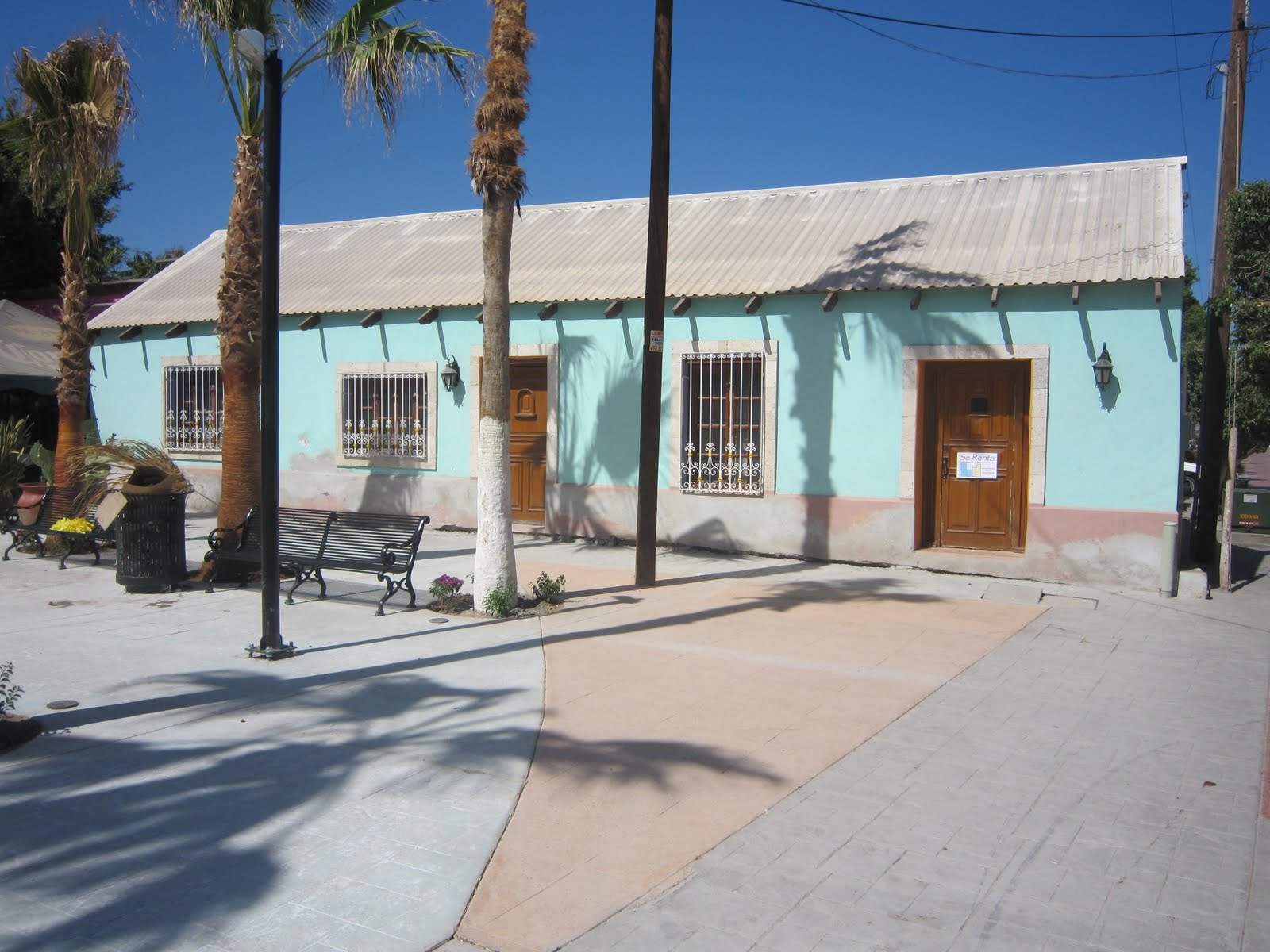
Around the square, the Posada de las Flores Hotel ,takes up half of one side with a wine and tapas bar on the ground floor and our Dorado Properties downtown office next door. The casa next to the office has just been converted into a senior citizens club which just opened. There is a beautifully restored old adobe casa on the adjacent side which has recently changed hands and will soon be the location of a new courtyard restaurant. Next door to that are two established restaurants; Mita Gourmet and 1697 (after the date of the Mission church a couple of blocks away). Mita has been there almost as long as I’ve been in Loreto, and Juan Carlos and family runs one of the best seafood restaurants in town. Kirin and Norma run 1697 with Kirin manning the kitchen from which emerges a variety of Italian and Mexican specialties along with an International selection of other dishes, particularly on their occasional Theme Nights.

The remaining side of the square is not as well developed. There is a large unfinished building on one corner taking up half the block (which I understand is owned by the Posada across the square, and may be developed into more accommodation some day) next to two old buildings that are not used much and are in poor repair. But I expect that as the economy improves and the town grows there will be more new developments around this square and things will continue to improve in the future.

This week was the occasion of a major celebration to commemorate the opening of the newly refurbished Plaza, six months after the project had begun. To put this in perspective, last November the word was that the project would be finished by Christmas. (Now if I was cynical (Blog forbid!) I might point out that they didn’t say WHICH Christmas – but I digress.) My theory is that there was a major push to finish the project by the end of April, in part, so the Plaza would be available for Cinco de Mayo. This traditional Mexican holiday has not been as “enthusiastically” celebrated here in past years as I here it is in places like Tijuana, (where many “Gringos” come across the border for the party) but perhaps that will change here this year and a new tradition may begin?

To give you an idea of the scale of the project the entire square block was scraped bare, new utilities were installed, old specimen trees were kept and more palms and other plantings were added along with a new band shell on site of the old one, complete with a water feature around 3/4 of the circumference of the structure. New patterned and coloured cement paving covers the rest of the square and creates a much more open space that can now accommodate a considerable crowd,

However, the crowd was not in evidence when I arrived, half an hour before I expected the official opening ceremony to begin. I wanted to get there early so I could look around and take a few pictures of the finished Plaza before people started to arrive. Some of the new plants were looking a little shell shocked from their recent transplanting, and there were more shrubs stored away that hadn’t quite make it into the ground in time for the party. A large sound board was set up in the band shell with video cameras trained on the raised stage in front of the Town Hall, where a long wooden desk stretched across the stage with chairs for about a dozen dignitaries.

I can’t verify this, but I wouldn’t be surprised if most of Baja Sur was left standing that evening, because almost every square foot of the rest of the Plaza was filled with neat rows of white plastic Tecate chairs – hundreds of them – so I’m guessing that they must have collected every available chair from all over the state to bring that many together in one place. OK, so maybe I’m exaggerating a bit, but the sight did remind me of all the white crosses in military cemeteries lined up in neat rows, on second thought, perhaps that’s a bit morbid – I’d better just get on with the story.

The first 6 or 8 rows of seating in front of the stage was roped off for VIP guests, with chair covers held in place with bright yellow sashes for the really important folks. Busily working among these chairs were a number of people that looked like secretarial and administrative staff, mainly women, all dressed in black with white tops (they obviously all got the memo) and they were attaching name cards to various chairs, after much consultation of lists and other sheaves of papers.

To one side of the stage there was an enormous video screen feeding live pictures from the several video cameras shooting the event. Scattered around the perimeter of the square, tied to just about anything that didn’t move, were large banners, inscribed with the names of many of the outlying hamlets and districts, that described some benefit that local area had received under the current administration, which is coming to the end of its three year term.

While these last minute preparations were underway I headed away from the Plaza along a side street towards my favourite ice cream shop for a snack. On the way there I passed a double row of what looked like every dump truck and other mobile piece of heavy equipment in town (perhaps that’s how the chairs had arrived?). The truck drivers were either sitting in their trucks or milling around in between - presumably waiting to play some role in the immanent event.

I arrived at La Michocana, where they have the most amazing selection of ice cream flavours and fruits for smoothies in town, but the specialty of the house, in my opinion, is the ice cream and frozen concoctions on a stick – dozens of them – neatly stacked in freezers – beautiful, and mouth watering! I made my choice, chocolate covered ice cream, of some subtle flavour, rolled in chopped pecans – delicious! Now armed with my treat, I returned, past the trucks, back to the square, and took a chair near the video screen, to wait for everyone else to show up. While waiting, I watched increasingly anxious, if not frantic, preparations on the stage by several “Assistants” in dark suits and striped ties, checking the PA system and making many announcements, about what, my almost non-existent Spanish, could not decipher.

Meanwhile, the Plaza was slowly filling up with hundreds of people, many women, mothers and grandmothers, with lots of young kids, as well as family groups, and younger single men and women. The atmosphere was festive, with everyone dressed carefully, if not formally. Vendors passed through the crowd selling small bags of different types of candies and nuts. Large coolers were scattered through the crowd, which were packed with bottled water and ice – free for the taking – and at the back of the crowd, there were a couple of hot dog carts and other snacks and drinks available.

As the crowd grew, more assistants, mainly younger, high school aged guys, started handing out pom-pom sticks of yellow paper streamers and small flags loosely translated as “Second Information Session”. These went over big with all the kids and quite a few adults, but the best was yet to come, long yellow skinny balloons, which proved to be a real crowd pleaser and were waved enthusiastically, as well as being used for many exciting games by the kids in the crowd, who found them a welcome diversion from the rather boring proceedings leading up to the event.

Finally, the head table appeared to be assembling at the front near the stage, and the mayor Yuan Yee Cunningham (I kid you not, he was born and raised in Loreto into one of the most important local families - and that is his name) worked the front of the crowd in the VIP area, to much cheering from that section of seats, and a muted, but still enthusiastic response from many in the larger crowd. Eventually, the official party was announced and entered from the back of the Plaza, lead by State Governor Narciso Agundez Montano accompanied by Yuan Yee and a hoard of well dressed officials and photographers (professional and otherwise) that slowly made their way through the crowd to a plaque, which was unveiled in mid plaza, to commemorate the event.

The official party then proceeded to the stage and finally took their places in chairs at the long desk. Next began at least a half an hour of introductions of the assembled officials and greetings to each of the outlying areas around Loreto, each place name being greeted with cheers, presumably from their residents, who were scattered around the Plaza. These official introductions were all very formal and, I’m sure run strictly according to a pecking order that would have impressed Miss Manners. Formal recognition and due attention to titles is an integral part of any even semi-official ceremony I have observed here in Mexico, and apparently is deeply ingrained in the culture.

Following these introductions there was a report by the Mayor, which, from what I could gather, was a laundry list of the accomplishments during his and the Governor’s terms of office. One of the high points in this rather dry fare happened when all of a sudden, in response to something the mayor had said, all of the assembled trucks I had mentioned earlier, started blowing their air horns in unison. I presume this noisy demonstration was in recognition of, and thanks for, the many civic contracts that these drivers had benefited from.

After what appeared to be an abbreviated council meeting, where several show of hand votes were taken among the head table – everyone got up and left the stage. Of course, at that point, I had no idea what had been said, or what the rest of the program would be, but I knew it would be going on for a long time and, after 2 hours, I had had about enough listening to speeches I didn’t understand. So, I took advantage of the break in the proceedings, to walk back to where my car was parked and then head back home the 15 km. to Loreto Bay. It turns out that I made the right decision to leave when I did, someone I spoke to later said that the festivities had gone on another 5 or 6 hours, finally wrapping up about 3:00 am after many more speeches and lots of music and dancing by various folkloric groups.

Participating, if only by observation, in an historic event of this magnitude in “my town” is a memory I am happy to share with you and preserve in this way. But I am ashamed by my lack of understanding of the language, and I am resolved to do what I can to improve my deficiency in that area in the future – however, in spite of my poor language skills, participating in the opening of the new Benito Juarez Plaza was a unique moment that I will remember as part of “Living Loreto”.
 
attraction