Sunday, January 9, 2011

Of Hockey - and Messing about in Boats!

For those of you who are not Hockey fans the context of this posting may not be relevant – but there was an International Under 20 Championship that has been going on since Christmas with the games being played in Buffalo NY. Canada’s team was not considered a favourite going into the competition (Canada had lost at the same tournament last year to the US) but after a few “soft” games to begin with, they had an impressive winning streak going and had beat the Americans in a semi-final to play the Russians for the Gold Medal.


I had a couple of Canadian friends over to watch the final game one evening this week and we were very impressed with the dominant way the Canadian’s controlled things for the first two periods and had an apparently commanding lead of 3 – 0 going into the final 20 minutes. Our cozy little Canadian Club was joined by an ex-pat American during the third period and, coincidentally, things began to change at about the halfway point of that period.

The Russians scored a goal – and another one 12 seconds later! It was now 3 – 2, with half the period to play! Another unanswered goal and it was now tied at 3, but not for long – next the unthinkable happened, 3 – 4 for Russia! As time wound down without Canada regaining the tie, spirits around the TV monitor were low and getting lower, until the game was put out of reach by Russia scoring their 5th unanswered goal and winning the Gold Medal!

Sad times in Mudville!

I am sure most of you reading this will appreciate what a tragedy such an upset is for born and bred Canucks! It is, after all, OUR GAME! And we had beaten this Russian team convincingly earlier in the competition. But to be beaten by FIVE unanswered goals in the last half of the final period – after leading 3 – 0 and dominating play for the first two periods – well it was a black day for Canadian Hockey fans!

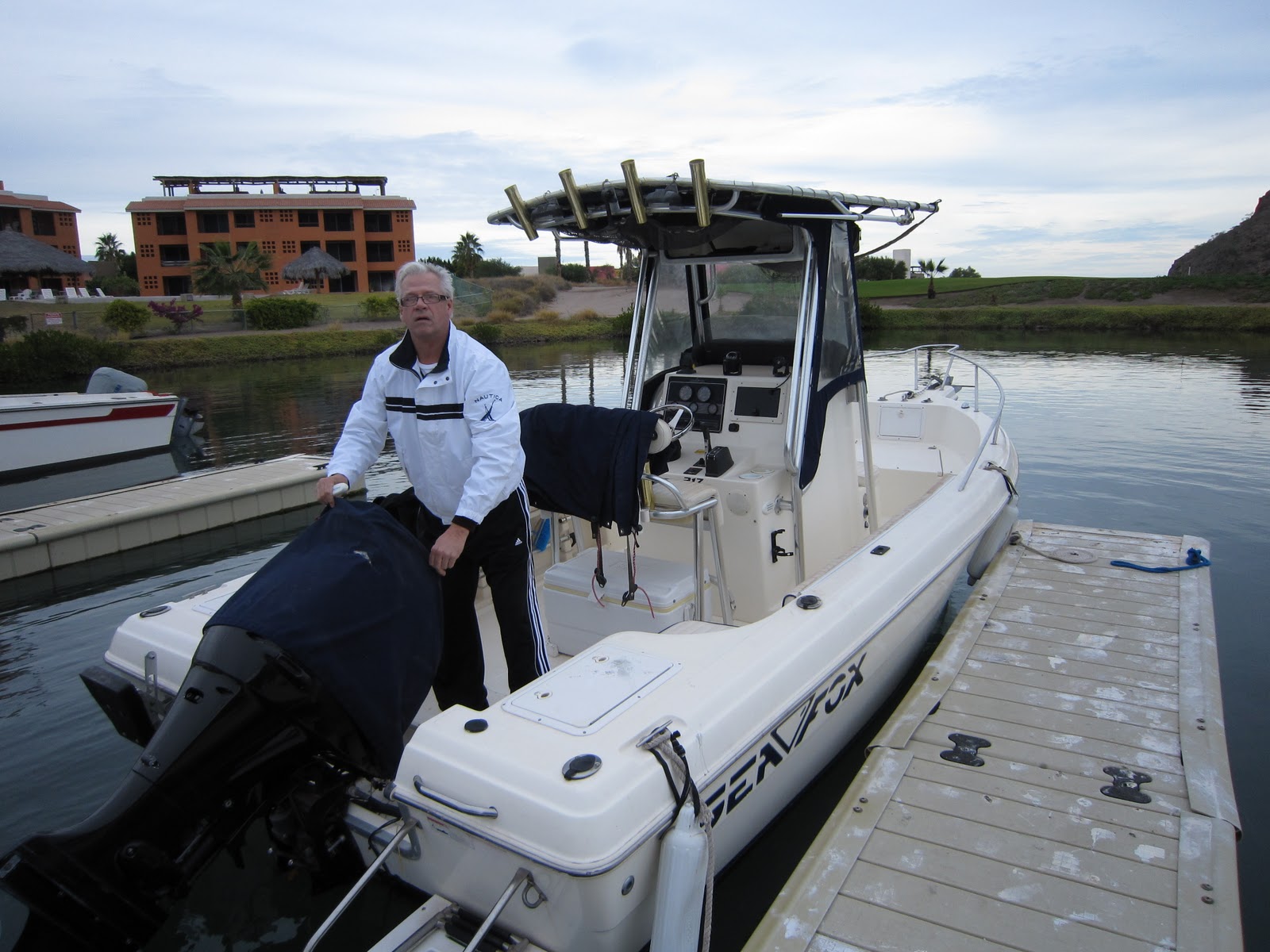
So, to cheer us up, after such a devastating defeat, our American friend invited us out on his boat the next morning – no particular purpose or destination, just a half day cruise south of Loreto Bay with some vague plans to finish up with lunch. Needless to say, our spirits were lifted and the bitterness of the defeat we had just witnessed was soon washed away with the sweet anticipation of our outing the next morning. It was decided that we would meet at 8:00 am, as the forecast was for calm winds in the morning with clearing skies.

This was important because it has been very windy the past few days, with unusually overcast skies – for Loreto – so the report of calm winds were reason enough for the boat captain to celebrate with an outing. Our Captain Robert, who is a Loreto Bay Homeowner, is lucky enough to have secured a marina slip on the estuary at the south end of the development so we had a short trip to the boat after we all met the next morning. Soon the four of us were aboard his nice center cockpit fishing boat and with little delay we were motoring our way slowly through the mangrove bordered estuary that winds through part of the Golf Course and out to join the Sea of Cortez. 

(I am trying out my new video camera so click on the link below and watch an unedited 4 minute clip of the beginning of our trip.)


Now, although there was little or no wind, there were still some heavy swells from the previous windy conditions, once we were in the open water off Punta Nopolo at the exit from the estuary, but we started to head south and although we rocked and pitched about some, it was wonderful to be on the water! Before long, we saw the choppy water break in a few places about 100 – 200 yards off our port side, either dolphins or seals, or both, but other than various cruising seabirds that was the extent of wildlife on this trip.


While I settled in on the bench in front of the cockpit and enjoyed the sea air and breezes and shot these pictures of the most beautiful part of Loreto – the water – my companions Grant and Tony and Skipper Robert chatted easily in the back of the boat. Although they were all Homeowners, they were here on visits of less than a month and their conversation touched on how they felt about heading back north. Once again, I was reminded how happy I was to be able to call this place home, and not have to think about leaving again for a while.

We passed outside Puerto Escondido and continued south past Isle Danzante heading along the coast until we were approaching Ensenada Blanca, where the new Villa del Palmar Loreto is preparing to welcome it’s first guests early in the New Year. With 171 villa suites, this resort will soon become one of the most desirable resort destinations in the southern Baja, with restaurants, a large spa and several pools. Although we could see that there was still some heavy work being done on the grounds surrounding the tower complex, the buildings themselves looked substantially complete and very impressive!

It was time to head back and so we turned about and made our way back to Escondido where we entered the harbour and tied up at the dock, among some large yachts. After stretching our legs a bit on shore, we determined that the Porto Bello Restaurant would not be open for about another hour for lunch, so we boarded our boat again and after a circle tour of the bay, where hundreds of boats could moor in protected waters, resumed our trip back to Loreto Bay.

Heading north was considerably “bouncier” than the outbound trip had been, due in part to the fact we were going a lot faster on the return, possibly because there was going to be lunch at the other end. As we re-entered the estuary and slowed down in the calmer water we were following several sea kayaks and then we passed a group of golfers teeing off on their 16th hole which dog-legs around the estuary – what a special place this is, where so many activities can be happening at the same place and time!

After tying up again in the slip, we washed down the boat and left it ship-shape for it’s next adventure, then, after many thanks to our noble Skipper Robert, we headed off to Del Borracho, a favourite saloon/restaurant for a feed of El Guapos, (loose translation “The Whopper”) arguably one of the best burgers in the Baja

So a story that began with disappointment at the result of a sporting event played thousands of kilometres away and turned into a mornings boat trip along the beautiful coast of the Sea of Cortez, and then concluded with great food enjoyed in a friendly atmosphere – this is the stuff that makes Loreto Bay such a wonderful place to call home and why I love “Living Loreto”!

SPECIAL NOTE: For any of you who have been thinking about visiting Loreto some day and sampling the lifestyle that I write about here, there may be no better time to make that trip! Alaska Airlines has just announced a seat sale to their Mexican destinations including Loreto - $119 + taxes, one way from LAX! You can find out more at the following link:

http://finance.yahoo.com/news/Alaska-Airlines-Announces-Low-prnews-800155303.html?x=0&

Perhaps you too will be Living Loreto soon?  Still not convinced?  Well, this week no less than The New York Times listed Loreto as #8 on a list of 41 places to visit in 2011 - the exerpt is copied below:

 8. Loreto, Mexico


A beach hideaway with sport fishing gets a luxury resort.


Long known for sport fishing, Loreto, on Baja California Sur’s eastern coast, is poised to become one of Mexico’s next luxury destinations.


On Wednesday, Villa Group Resorts, one of Mexico’s largest privately owned hotel groups, will open a $60 million Villa del Palmar resort with three restaurants, a 20,000-square-foot turtle-shaped pool and 150 suites from $250 to $1,500 a night. The resort is the first phase of an 1,800-acre development, Danzante Ba. It will add seven resort hotels, restaurants and a Rees Jones golf course.


Loreto also has longstanding attractions to tout. It recently started a public relations campaign, with help from the Mexico Tourism Board, to highlight its colonial architecture, deserted beaches and marine life. Founded in 1697 by Jesuit missionaries, Loreto is home to the historic Mission of Our Lady Loreto, one of the first “California” missions. The baroque Mission of San Javier can be found nearby in the Sierra de la Giganta Mountains.


Visitors can take day trips to see prehistoric rock art in the Sierra de San Francisco region of Baja California between Loreto and Bahia de Los Angeles. Five islands that make up the Loreto Bay National Marine Park, which covers 797 square miles in the Sea of Cortez, offer extensive snorkeling, kayaking, hiking, whale-watching and scuba-diving opportunities. The area is home to more than 800 species of marine life, including six-foot-long Humboldt squid.


— MICHELLE HIGGINS

You can read the whole article here:


Saturday, January 1, 2011

Happy New Year - In Loreto!

Happy New Year!


I am writing this while I am enroute (at 35,000 ft.) back to Mexico after spending the last three weeks visiting family and friends in Calgary. While the Holiday season is a good time to renew the connections, and I have enjoyed spending time with these people who live so far away from Loreto, I am excited and happy to be on the return leg of my journey.

The most obvious thing I have missed over the three weeks I have been away is, of course, the weather. When I left from Cabo the temperature was about 30 degrees Celsius and when I arrived in Calgary it was minus 17 – almost a 50 degrees difference! Although the temperature has fluctuated during my stay (it got up to plus 4 on Christmas Day) it has been a sharp reminder of the sort of weather that I grew up with, although I was never one of those people who claimed to ENJOY the winters in Canada.

But even more than the temperature, I think the thing that struck me most was the amount of sunshine – or lack thereof - that northern latitudes receive at this, the darkest time of year. When the sun did shine it rose late, and set early, and it was so low on the southern horizon – bearing in mind that Calgary receives more sunny days a year than many other places in that latitude. It continued to be a shock throughout my visit, to experience this scarce amount of light on a daily basis, particularly after having adapted to the almost continuous 11 hours of sun I had been enjoying in Loreto. Although I was conscious of my southern tan fading almost on a daily basis, some people were still remarking right up to the end of my visit “How tanned you look!” – I guess these things are relative.

Another vivid impression from this trip is the adaptability of the human body and spirit. While there are certainly extremes of temperature and humidity in Mexico, particularly during the summer months, and even the potential for occasional extreme weather events like Tropical Storms or Hurricanes in the Fall. But when it’s minus 27 degrees with the wind chill, exposed skin can freeze in a matter of minutes and there is a real risk of death from hypothermia, if one is not careful and prepared for the Canadian winter. And yet, in spite of these potentially lethal conditions, most people go about their day to day activities with remarkably few changes from their routines at more temperate times of the year.

One of the things that struck me most, was that I was making these observations as someone who had spent 90% of my life living and working in Canada, and while I grumbled and complained my share about the weather during that time, I never really thought about it as being abnormal – it was just the way things were. (I’ve heard it said that the reason Canadians spend so much time talking about the weather is that we have SO MUCH of it to talk about!) But now that I spend more than half the year in one of the most ideal climates on the continent – how soon I forget! So now I watch with wonder as I see people, old and young, fit or frail, coping with ice and snow, slippery streets and hazardous walks, bundled in winter coats and boots – apparently oblivious to the extreme conditions that they take for granted at this time of year.

But my reactions were not all about the weather. One of the biggest adjustments was the pace and complications of life in a busy urban environment like Calgary (population 1 million). To begin with – traffic! Between weather related slowdowns, commuter rushes, and construction delays, I found that I could spend a significant part of the day either trying to get to somewhere, or get back, or find somewhere to park while I was there. This situation was of course exacerbated by the time of year and the incredible amount of time and effort that goes into Christmas shopping in the North American consumer society.

With acres of cars packed around huge indoor Malls, the first challenge is just to find a parking space within sight of where you intended to go! Once you are inside these temples of commerce you are then surrounded by all the people whose cars are parked outside – the oldest and youngest with their various wheeled vehicles in common – and everyone else carrying numerous bags and packages. The people seem oblivious to the intricate decorations and displays that surround them as they work their way through the steady flow of shoppers making headway to their next destination in search of even more to buy.

When I see this scene of consumerism gone overboard I can’t help but compare it to the quaint, by contrast, alternative in Loreto. Simply put, shopping in Loreto is a necessity, not an activity. People buy what they need with a minimum of fuss and bother – primarily because there isn’t all that much to buy, beyond the everyday necessities. Sure, the toy aisle of the local Pescador supermarket is stocked with a larger variety of simple and inexpensive gifts, and there are some temporary kiosks set up with seasonal decorations and you can even find the odd natural Christmas tree for sale. But Christmas in Loreto is about things other than THINGS – time spent with family and friends, the church, posadas or parties where traditions are not measured by how much you spend and who you buy for.

But, as I reflect on the past several weeks spent in a place far away – that I used to call home – I am struck by how demanding the pace and complexity of life is for those people I have left behind, and how simple life can be in a place like Loreto. How it is not uncommon for my Loretano friends and neighbours to comment on how they manage to keep “busy” day to day, even though they are hard pressed to explain, or sometimes even remember, how they spend their time. How accomplishing one, seemingly simple task, represents a satisfying achievement for the day. How a trip into town to buy a few groceries, or just a walk on the Golf Course with the dog is a reasonable agenda.

I will admit that sometimes I have found myself chaffing at the slow pace of life in Loreto, and the time that it can take to accomplish seemingly simple things. But, as I return home after my visit to “the Great White North” perhaps the biggest gift I am bringing back with me is a renewed appreciation of the simple things that can be easily overlooked with familiarity. My return is also one of those “learning moments” where I take measure and realize how this special place has begun to change me from the winter dwelling, high achieving, materially driven person I was, into someone who lives in a different rhythm and is beginning to reflect those changes day to day, as I experience and learn about “Living Loreto”.

Let me say it again – Happy New Year!

Sunday, December 19, 2010

Sandals, Bath Tubs & Bikes!

Currently I am back in Canada visiting family and friends over the Holidays and so I asked a Homeowner and friend Steven, to offer some thoughts from a recent visit he made to Loreto Bay which follows. It is my theory that everyone has a “Blog” in them and Steven’s offering proves my premise to be true again. Living Loreto will be on hiatus until the New Year when I will be back home in Loreto and look forward to resuming my regular postings.


At this time I wish all of you a wonderful Holiday Season and all of the best for a safe, happy and prosperous New Year! I hope you will return and visit Living Loreto in the New Year, and my thanks for your past visits!

DUSTY FEET

You cannot visit, or for that matter live in Loreto, without getting dusty feet. This is a problem that all of us are familiar with. We can’t wear closed toed shoes-they are way too hot and mark you as a geek, so we pad around in flip-flops and sandals. Even Nellie Hutchison, the best dressed gal in Loreto Bay, wears sandals, although they are styling to the max with stiletto heels.

I think I have finally figured out why Loreto Bay Company installed all those fancy bathtubs in our homes. You have to admit - as a sales feature, they make a great impression. They are beautiful, whether they were decked in Mexican tile or Travertine marble. But who really uses the damn things? I suppose some folks do take baths here, but I am guessing that the vast majority of us take showers and those bathtubs just sit there looking good but do not get used all that much. We even begin to feel resentful of them-they take up valuable space that we could use for storage.

Maybe the geniuses at Loreto Bay Company realized the problem of dusty feet could turn into an epidemic and gave us each a perfect way to solve the problem. Maybe to save ourselves from the pain and embarrassment of going to bed with dirty feet and soiling our nice sheets we were provided with the perfect solution. We can use our bathtubs to clean our feet each night. We can start a new bedtime regime-brush your teeth and wash your feet in the privacy and comfort of your own bathroom.

I stumbled upon this perfect use of the bathtub the night of attending the Baja 1000. Drew McNabb picked us up at 6 a.m. and we travelled to the Baja Pits behind the Pemex station just in time to see some of the off-road vehicles and moto-cross bikes pull in and re-fuel, or fix whatever was ailing them. Amidst the pandemonium of the event, you could not help but be covered in dust. From head to toe. In each ear and nostril. A complete cover job.

But we were back in Loreto Bay by 10 a.m. and went about our day in the usual way. When we finally turned in that evening, my feet were just filthy, as they are just about every day I am in Loreto. Well, sometimes you just don’t feel like taking a shower at 9 p.m. but you always feel like going to bed. What do you do with those damn feet?

The bathtub! It is a perfect perch to rest your weary bones on while you step those ugly feet inside and turn on the water. You can just sit there and gaze at the swirls of grime going down the drain as your feet emerge clean and fresh and ready for bed. You can add to the satisfaction by waiting for the water to get nice and warm and then going for the full spa-like treatment- you can massage those puppies with a wash cloth and really go first class. You can even finish the process with some skin lotion (I never did this - I just thought of it right now). Combine that with a brisk brush of the teeth and you are ready for anything - even sleep! So don’t let that bathtub just sit there like a beached whale. Use it and give it the satisfaction of knowing it is fulfilling a purpose-to make each of us cleaner and happier as we get ready for sweet slumber.

THE BUZZ AND THE BIKE

We felt it as soon as we got to Loreto Bay. There is a buzz of energy about the place. The Inn looks and feels great. The brightly colored paint job, the new covered dining area, with white table clothes and white chairs adjacent to the exercise room by the pool, the restored palapas on the beach, the new deck furniture at the pool, the increasingly professional attitude of the staff at the Inn, all combine to make going to the Inn a pleasure again. It just feels good to be there. The food is also very good. We enjoyed one buffet dinner and one breakfast. Both meals were outstanding. You can also open an account at the Registration Desk-just provide your casa number and a credit card and you can use the account while you are there and pay one credit card charge at the end of your stay. It was easy for us and will be for you too. WOW! What a difference from last year.

Everyone is abuzz about the Paseo being paved, which is a good thing. But it also shows that our new neighbor, HOMEX, is serious about making Loreto Bay a success. They want this place to succeed, and they are putting their money on the table to make it happen. I am of the opinion that the new phase of homes being built and sold to a primarily Mexican audience is a great thing for this community. A mixed race community of Mexicans, Americans and Canadians can only be better, on many levels, than one dominated by just Anglos. There are many phases of development to be completed, including the beautification of Agua Viva, but for me, this year represents a huge step forward.

The expanded and relocated Baja Onsite Community Store is such an asset! Evan and Julie work hard to make things available to us that we need or want, without having to drive into town. For those of us who desire to stay out of cars, this is HUGE! We can all ride our bicycles to get what we need that day.

Speaking of bicycles, we have used them on our last two trips as our primary means of transport, and we heartily recommend them to our neighbors. You can go from one end of the Village to the other in no time at all, and then throw in a trip to Agua Viva, which takes all of five minutes. The exercise feels great, the breezes cool you down, and the ride through all that gorgeous landscaping is just plain fun. We like the bikes with big fat tires - you can bring one down on Alaska Airlines for fifty bucks, so perhaps it is time to get on board?

What an exciting New Year for all of us in Loreto Bay. I LOVE THIS PLACE!

Sunday, December 12, 2010

An Auction Where Everybody Wins!

Next to Homeowners, the most numerous group of residents in Loreto Bay have four feet – mainly dogs, but also a few cats. While many of these “best friends” come from northern homes, a surprising number have been adopted here in Mexico – a situation I refer to as the pet equivalent to winning the Lottery!


This analogy is particularly true if you are familiar with the sad situation of the many stray dogs that can often be seen in and around most places where people are found in Mexico. It has been an unfortunate fact of life in Mexico for many years, that packs of stray dogs, usually malnourished and often injured, make noisy pests of themselves. This was certainly the case in Loreto when I first started coming here, and in the Loreto Bay development, during the more than five years of intensive construction, there were many such animals “living” off the leftovers of hundreds of workers that were building the homes.

Given the number of pet-owners among the Homeowners here it is not surprising that there is an active and successful organization concerned with the welfare of the local animal population, that organization is called Animalandia. Their mandate is primarily to spay and neuter both feral animals and those owned by local Mexicans who cannot afford to pay for these operations. However, they explicitly do not want the services they provide to interfere with the livelihood of the local vets who are charging the people who can afford the cost of these procedures.

Animalandia works closely with Vets and Vet technicians from the US and Canada who donate their time and expertise and travel to Loreto several times a year to hold free clinics where they perform dozens of operations over a few days of intensive work. For this these volunteers receive free accommodations, often in the homes of Animalandia members, and their meals while they are in town. The clinics take place in a small facility that has been recently built by Animalandia, where up to four operations can take place at the same time. In addition to this facility, the organization also provides all the medical supplies required for the operations, some of which they receive as donations.

Another important role this group plays is to act as an adoption agency, finding homes for the rescued animals after they have been operated on. While many of these adoptions take place in and around the town of Loreto, including Loreto Bay (see prvious posts: “It’s a Dog’s Life” Dec. 2009, “A Dog’s Life Loreto Style” Jan. 2010), with the relatively small population base here a surprising number of adoptions take place north of the border in the US and Canada.

One of Animalandia’s main fundraising activities is a silent auction that receives contributions from many local businesses including Hotels and Restaurants and professional services including esthetics and massage as well as art and crafts, household goods, sport equipment and activities. In such a small community this sort of event takes on even more significance because many of those who contributed these goods and services also attend the event and further support the charity by bidding on auction items.

Last weekend, this auction was held at the Inn at Loreto Bay thanks to the support of the Manager Peter Maxwell.  In addition to providing the use of their open air bar and reception area as the venue, the Inn also contributed a generous spread of appetizers and some auction items of meals and accommodations.  I was pleased to have been asked to provide some music and act as a quasi-MC, using my portable PA system (which is turning out to be a great way to get invited to good parties!).

When I arrived to set up my equipment, most of the preparations had been completed by Animalandia volunteers, auction items or their descriptive sheets, were displayed around the perimeter of the mezzanine and bidder’s sheets with pens were placed with each item. A long table was set up at one end to hold the finger food and the cash bar took up another side. The rest of the area was filled with groups of tables and chairs. At the entrance to this space, which is upstairs from the lobby and overlooks the Hotel courtyard through to the beach on one side and the Sierra Gigante mountains on the other, was a display of many numbered door prizes and a desk where a small admission was charged and additional donations could be made.

I set up my equipment at one end of the bar and began to play music while some last minute auction items arrived and the final preparations were made. Shortly after the 3:00 pm start time people started to arrive and soon the space was filling up, with mingling over drinks and nibbling on the tasty food. Bidding strategy began to become evident – the early in, the wait and see, the bid and ignore, and the stand guard – all were represented! One of my jobs, as well as the music, was to announce winning ticket numbers for door prizes, and, due to the generosity of the many donors, a good percentage of those in attendance went home with one of these many prizes.

But the bidding and door prizes, the drinks and snacks, were not the only reason there were almost a hundred people in attendance. Although many people who live here in Loreto Bay have friends who live in the town 15 km away – and vice versa - so far, there have been a limited number of events where the two groups mingle, and only a few of those activities where the “townies” come out to Loreto Bay. So the welfare of the animals, both here and in town, was one of those opportunities and everyone present seemed to enjoy it!

There were even some four legged guests in the crowd – including one of the newest “rescue” dogs who had recently been found in very poor condition and, after the Vet provided some first aid, she was now being taken care of by a “foster” owner until a permanent home is found. Although the prominent rib cage told something of the hard life this dog had lived up until recently, at this auction/party she was happily excited to be surrounded by all these people and seemed to be responding very well to her improved living conditions – like any Lottery winner!

After several hours of bidding and visiting the auction sheets were pulled, starting with many from the supportive Hotels and Restaurants and working the way through the dozens of other desirable items and services which were on offer. I read out the “winning” bids and volunteers were kept busy receiving payments in exchange for the actual items or their certificates. Gradually the sunny afternoon had turned to early evening and the generous people who had attended made their way home, many with a new treasure, or looking forward to a new experience that they had bought.


In the seven years that Animalandia has existed here in Loreto they have made it possible for over 4,500 spay and neuter operations to be performed – and so eliminated many thousands more unwelcome and uncared for animals that would have plagued our community. In addition to this they have also arranged many adoptions of rescued animals, bringing untold love and joy to these animals and their adoptive owners, both here and in many other places in the US and Canada. If you are interested in learning more about this organization, or making a donation to support their good works (they are currently offering a great wall calendar with local children’s artwork and stories about adopted dogs) please visit their website: www.animalandia.org

While this is the second Blog in a row with a subject involving charity, I am somewhat uncomfortable drawing any parallels or comparisons between the good works of last week’s subject Caritas helping the people of San Juanico and this week’s story about Animalandia. In my mind there is no way to equate between the needs of people with those of animals.

But as we enter the Holiday Season and our thoughts turn to the act of giving to celebrate this time of year, far be it from me to judge the relative motive or effect of these two examples of generosity and care. Suffice to say, for those of us who are lucky enough to call this beautiful place home (or the many more that will do so in the future) the willingness to share our good fortune with others is one of the best parts of Living Loreto!

Sunday, December 5, 2010

My Trip To San Juanico

This past week I had a remarkable experience which will be a challenge to do justice to on these pages. As regular readers know, many of the subjects for my Blog this Fall have centered around parties and other social events that have happened here, mainly among the ex-pat community. One of those events was the Paella Cook-Off (“Paella Cook-Off III”, Nov. 7th) which raised almost 50,000 pesos ($4,000 US) for charity.


These funds were going to be divided three ways. One third was going to the Internado, a residential school for children who are bussed into town for their weekly classes and returned to their homes in outlying areas for the weekends. Another third was to be a contribution to the local Optimists Club children’s fund. And the final third was designated for Caritas, a volunteer charitable organization that helps some of the poorest people living in surrounding remote areas.

Recently I was invited to accompany Shelia and Manfred (who were the organizers of the Paella event) when they joined volunteers from Caritas to go out to distribute some of the aid that was made possible by the contribution of funds their event had raised. Of course, I welcomed the opportunity to learn more about some of the people and places that surround Loreto Bay, where I make my home. I also saw the potential for a Blog subject that would somewhat balance the “party, party, party” theme that has somewhat dominated these pages recently.

Part of the experience of life in a foreign country, is being surrounded by extremes in standards of living. Although within Loreto Bay we live in a homogeneous community of more or less comparable homes, mainly occupied by people from the US and Canada, fifteen kilometres away in the town of Loreto there is a much broader range of living conditions. These vary between large oceanfront residences, through middle and working class homes in the town proper, and to areas of extreme poverty on the outskirts of town.

But beyond even this range of extremes, there are isolated rancheros raising cattle near oasis in the miles of rugged desert that makes up most of this peninsula, and remote fishing settlements that are located where there is an accessible beach with some protection and good fishing nearby. These are the sort of places where the children who are the students of the Internado school system come from, and they are also the charitable focus of the Caritas organization.
                                                                                                                                                              Our destination on this day was a small bay north of Loreto called San Juanico, where a couple of dozen people in eight family groups live and subsist by fishing in the surrounding waters of the Sea of Cortez. Shelia, Manfred and I met with three local volunteers from Caritas in Loreto and we followed them about 50 km north of town where we left the highway and took the most primitive of roads east towards the ocean.

Any travel off the main highway here usually involves going through sections of arroyo, or watersheds where the occasional downpours drain surrounding hills into the ocean. After crossing through scrub brush near the highway, we entered an area of large cactus and sections of the dry gravel arroyo before coming to rocky outcrops that were at least four stories high, where the channel narrowed and we could see signs of erosion on the volcanic walls. Considering we were driving on bone dry sand and gravel, this erosion takes on more significance. When there can be years between flood events, and then they can last for only days, or possibly a week or so, the mind boggles considering the millennia of time it has taken to erode this hard rock from these infrequent deluges!

In the same area, we passed through a page wire gate that controlled free-range cattle in the area. This gate was over 6 ft. high and caught in the joints at the top of the wire mesh were wisps of dried grasses which must have lodged there the last time a torrential flood had exceeded 6 ft. depth in this restricted channel. We also saw ``Palo Blanco`` trees growing out of solid rock walls where they somehow found a source of water sufficient to support life.

After driving 15 km from the highway, we were approaching the ocean and our destination. At the end of a sandy stretch of road through the shoreline brush and mangrove we arrived at the small cluster of homes that was the fishing settlement at San Jaunico. The quality of these buildings varied considerably – there were a few newer looking plastered concrete block buildings, but others were made from plywood or corrugated fibre panels – even salvaged scrap timber and plastic canvas sheets.

When we arrived the Caritas volunteers were greeted as old friends by a couple of women in their 20’s carrying young children, Manfred, Shelia and I were included in introductions and handshakes as others joined us, including the apparent matriarch who was probably in her 60’s and the “head man” who may have been in his 50’s. Initially, I was wondering why there were no older children around, just adults and toddlers, and then I realized that all of the school aged children were probably enrolled in the Internado, getting their education in Loreto, where they lived between weekend trips back home.


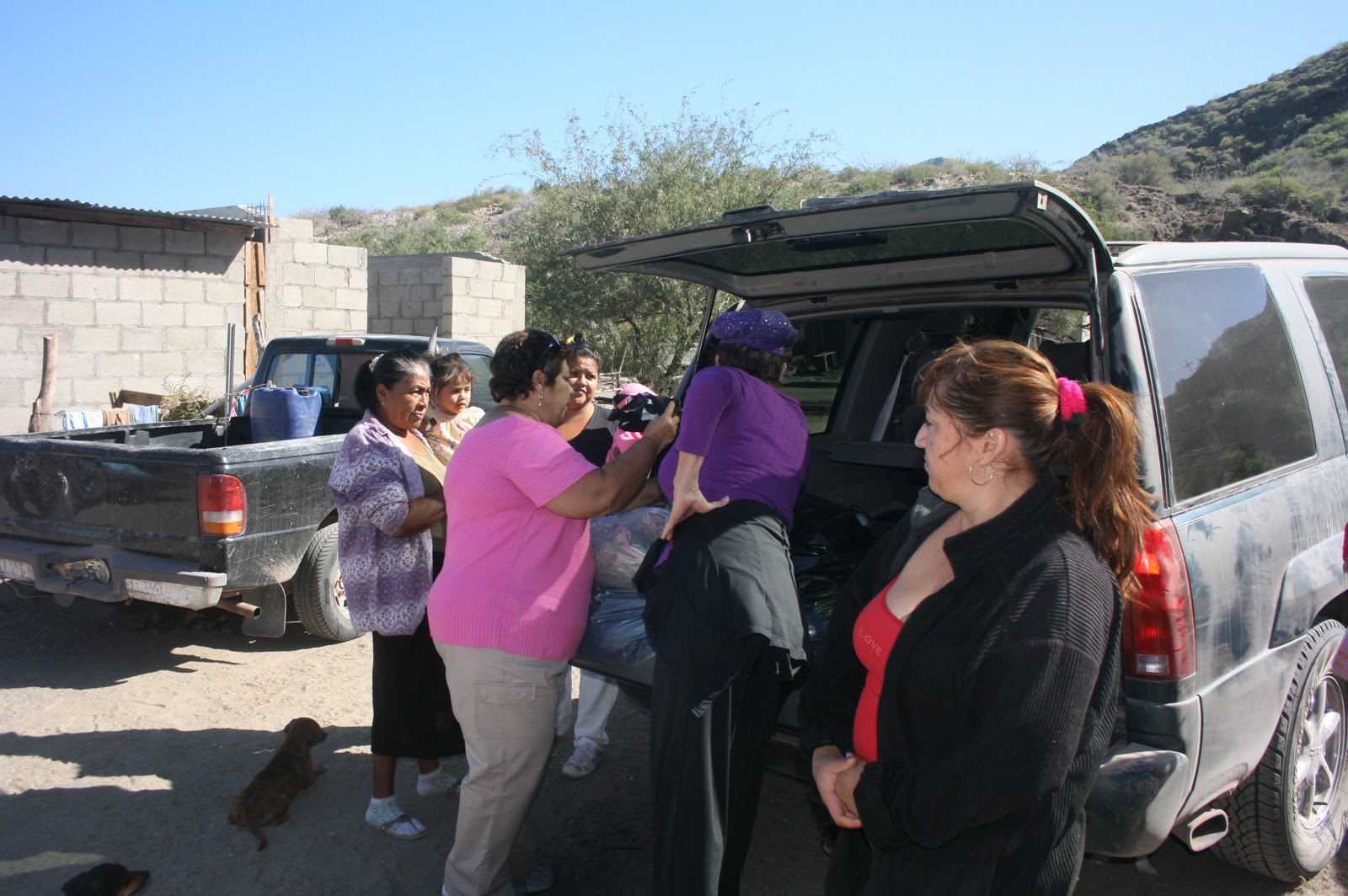
After the introductions, and some discussion about what supplies we had brought them, the women gathered at the back of my car where the bags of donated clothes, shoes and bedding were opened and distributed. This process took on the look and feel of a friendly “rummage sale”, with each item being inspected and chosen by one or another, based on size and appropriateness. If an item was not suitable for any of them, they always seemed to know of someone else in a nearby ranchero or another fishing camp up the shoreline that could use it.


While the women were thus occupied, I wandered around the cluster of buildings and learned a little more about how these people were living. Several of the men were assembling fish nets, tying nylon mesh between two ropes, one of which had plastic floats spaced out along it’s length, the other with small lead weights. Based on the pile of finished nets, and the materials ready for assembly, they were going to have hundreds of feet of it ready for fishing when they were finished the job. A flock of about a dozen goats appeared from over the rocky cliffs at the south end of the beach and they were quickly marshalled into order by several of the numerous dogs that were obviously “at home” in the community.

(I had asked that the Caritas people explain to the residents that I was taking these pictures to publish in my Blog (not sure how familiar these people would be with THAT concept!) and I wasn’t just being “nosey”, so I felt reasonably comfortable taking these shots.)

There was a small structure, open on one side, facing the Ocean, inside of which there was an altar, a cross and Icon, some floral arrangements, and a decorated Christmas tree – their Church, for which, I later found out, they wanted to build some benches so they could sit for the services they performed for themselves. There was some tinsel bunting wrapped around a tree outside this Church as well – that added an incongruously festive touch to these primitive surroundings.

At the base of the rocky cliff that wrapped around two sides of the beach there was a small garden patch with 4 foot corn plants around the perimeter, and I saw tomato plants, and a row of cilantro as well as small shrub sized orange and grapefruit trees that are years from bearing any fruit. Two 40 gallon sized plastic drums stood beside the garden, holding the fresh water for irrigating the plants, a reminder that all of their water had to be hauled in. Apparently they had set up a simple water system sometime in the past, pumping water from a well and distributing it to the homes through plastic piping, but now the pump no longer worked and they didn’t have the money to replace it. These few plants were their only source of fresh fruit or vegetables (other than what they could buy or barter for) and they were sturdily protected from the healthy appetites of the goats, which, by the way, provided these people’s source of fresh milk, as well as fertilizer!

Further along the rock cliff, towards the beach the head man, Jorge, pointed out a small cave opening that went about 12 or 15 feet into the rock and was 6 or 8 feet wide and 4 or 5 feet high. I saw some tools and equipment stored inside and took a few pictures. But then, with some translation help, Jorge explained than he had LIVED in this cave for the first year he stayed here, before he was joined by family and the community began to grow here five years ago. After learning this, I looked back at the cave with new respect for the will and determination of these people – and a different appreciation for the progress that this modest collection of simple shelters represented.

Making my way down to the beach I saw the half dozen pangas pulled well up onto the shore, far from the crashing surf that was still running high after the recent strong winds. These fishing boats, despite their tired appearances and elderly outboard motors, were the most important assets of the community – providing the only means of support for the families who lived here. The fish they caught, in excess of their own needs for food, were taken into Loreto to sell and the small amount of money that provided purchased everything else that sustained them. Including their drinking water and, the vital ice they needed to store the fish between trips to town. The ice explained the numerous rusty old refrigerators that were scattered around most of the homes, lying on their backs, filled with this precious commodity that had to be constantly replenished.

In the midst of these simple homes and primitive surroundings there was one incongruous, but very important hi-tech element – solar power panels. Adjacent to most of these little buildings there was a steel mast topped by small solar panel which would charge a battery and provide enough power for low wattage lighting inside at night. I also saw another example of the inventiveness of these resourceful people, one of the boats also had a small mast mounted with a small fluorescent light fixture (covered by a clear plastic bag to protect it from water) which was connected to the outboard battery to provide a little light for night fishing. But the unique part of this equipment was the switch for the light which had been fashioned from a medical syringe, push the plunger in and the light went on, pull it out and it turned off – a foolproof, and waterproof solution that was an inspiring example of recycling!

As I made my way back to the homes, the clothing had all been distributed, along with the food hampers that Caritas had brought that contained a standard supply of basics like rice, beans, oil, milk, cereal, dried soup, some fresh vegetables, canned tuna and soap. They also had brought 20 litre bottles of water, all of which were carried off into the different homes. With our trucks now empty we were about to get things together to leave, when we were asked if we would like some fish. Of course, an offer of some filets of fresh fish is always welcome, and as this was the only thing they had that they could give us in appreciation, we of course said yes, enthusiastically! But we were wrong – they weren’t offering us some fish to take away with us, no, these women were going to prepare a meal of fish for us!


While several of them set to work in the “kitchen” of one of the larger homes, we were asked if we would like to meet Sabas Saul, the 84 year old patriarch of the community, who was quite ill in bed, in a shed-like addition on the newest and largest house. We were taken to him and introduced as he lay on a tired looking bed frame covered with bedding and quilts, dressed in several layers of clothes against the chill in the air. His wife, the matriarch we had met soon after arriving, explained his ailments to the Caritas people, and asked for simple things like antacid for his chronic stomach problem, ibuprofen to relieve muscle and joint pains. These simple over-the-counter medications obviously could only do the very minimum to relieve some of the pain and discomfort that this old man was living with, and yet they were beyond the reach of these proud people who were asking for help. The good people from Caritas assured the wife that they would see to these needs on their next visit and, with that, we left him with our good wishes and a sobering grasp of the reality of how hard this life can be at the end.

We returned to sit under the patio roof outside the other house, where there were now delicious smells of fried fish in the air. The six of us sat around the plastic table that held a towel wrapped stack of fresh warm tortillas, a bowl of fresh chopped tomato, onion and cilantro salsa, and then a large dish of golden fried fish fillets arrived out of the darkened door of this modest home. And so began one of my most memorable – and delicious – meals here in Mexico.

This simple food was delectable and perfectly prepared, but the secret ingredient that made it a meal I will not forget was the genuine hospitality of our hosts, the fine, proud and independent people who had chosen this harsh, but beautiful place to make their claim for a simple life so far away (in many ways) from everything that made up the world that I take for granted every day.

Having the privilege to participate in the simple act of giving a little to people for whom it means so much – and then to receive a delicious meal, from the people we have just provided a small supply of the basic staples of life. This day, and what I learned about decency, self-respect, and hospitality will be one of my most valuable lessons in “Living Loreto”!

(From what I have seen, I am very impressed with the good work of the Caritas organization here in Loreto. If my story has inspired you to consider making a contribution to aid in their efforts to help some of the most deserving, I would be very happy to provide you with wiring instructions to make a deposit to their bank account. Just email me (my address is at the top of this page) and I will forward the information.)


Sunday, November 28, 2010

Giving Thanks – for a road – maybe!

As someone who is lucky enough to call a beautiful place like Loreto Bay “home” it is not difficult to find things to be thankful for – the weather, the Sea of Cortez, the people and the community that surrounds me for starters. However, on this, the U.S. Thanksgiving weekend, we who are living here have added another thing to that list . . . a road!

For those of you not familiar with the history, a little background is required. The road that bisects this development was built many years before there was anything else here, and with the traffic and construction work over the last five years of the development of the Founders Neighbourhood, it has deteriorated significantly. Almost two years ago work started on resurfacing the road and most of one side of the divided street was torn up in preparation. Unfortunately, this timing was bad and before constructive work could begin, the previous Developer, who was to be contributing funds to the project, ceased all operations and we were left with a worse situation than before. Half the road was compressed sand and the remainder was old asphalt, potholed and broken in many places.

Therefore, during the most of the time people have been living in the Loreto Bay development we have had to deal with a “substandard” (to say the least) road through our community. This situation has been further complicated by the fact that the road itself is not owned by our Condominium Regime, it is controlled by Fonatur (the Mexican Government’s department that is responsible for administering tourism, among other things) and, as such, beyond our control, even if we did have the funds to fix it, which we didn’t.

Earlier this year, when Homex (the new Developer) purchased significant assets that belonged to the previous Developer including the Inn, Golf Course and a parcel of land for future development, one of the issues that was the subject of great speculation among many Homeowners was “Would Homex fix the road?”. My opinion from the beginning was, simply put, Homex would likely do whatever was in Homex’s best interest. And, since they owned a Hotel at the south end of the development and were going to be building hundreds of homes at the north end – connected by this road – it always seemed clear to me that, yes, Homex would fix the road . . . when they wanted to.


Well, that day appears to have come – maybe. Last week Homex informed our Condominium management that parking needed to be restricted on certain stretches of the road because work was going to begin last Thursday. And it did! Did it ever! Men and equipment appeared and work began. Graders, back hoes, rollers and dump trucks with dozens of workers started the big job last week and work has continued ever since, late into the night and on the weekend.

So far the progress has been impressive, with work starting on the south entrance, forming concrete curbing for the relatively new paving on that stretch, and major work has been done on the “T” intersection where that road joins the main Paseo road near the Inn. From there to the Inn, the old asphalt has been torn up and a new roadbed has been graded. From about halfway down the Paseo, towards the north, the west side of the road, which had been left as bare sand after the initial work stopped several years ago, new roadbed has been graded and compacted and forms for curbing are being assembled.

The uniquely Loretano aspect of this project is that apparently no one except Homex actually knows what the extent of work and the timetable is going to be – and, so far, they aren’t talking! So the speculation about “if and when” the road will be fixed has been replaced with new speculation about “how much and where”. But the undeniable fact is that THE ROAD IS BEING FIXED! And the work is being done in a timely, efficient and obviously professional manner - which is a refreshing change from what many of us have experienced here in the past.

Although I do not normally participate in speculation – particularly on these pages – it is my opinion that the work will be completed and the Paseo will be fully (and beautifully) paved possibly in time for the New Year. While having a nice new road will be one of the most important improvements to the infrastructure in the recent history of Loreto Bay, I think the significance of this project is even greater than the obvious benefits of the road itself.

The new road, when it is completed, will become a positive and tangible symbol and statement about the current health and future potential of this development. From my professional perspective, (with my Real Estate agents hat firmly in place) I know how important that symbol will be in making a positive first impression on visitors and potential buyers of this project. In the past, without exception, I have come to expect the inevitable questions from those visitors and prospects about the condition of the road and what was going to be done about it.

Going forward, no such explanation will be required, and the evaluation that these people will make, in the absence of such a glaring deficiency, will undoubtedly be that much more positive as a result. While it is easy to foresee the positive impact that removing such an obvious negative will have on those seeing Loreto Bay for the first time, it is perhaps more complicated understanding the effects it will have on those of us who are long term residents as well as the Homeowners who stay here for shorter term visits.

Community pride will no doubt be positively impacted – that goes without saying – and I expect that there will also be a significant confirmation of their faith and confidence in their decisions and choices that have brought them to this place, where they have made an emotional as well as financial investment. But I also know that the majority of the people who make up this community are a special group. What brought them here in the first place was obviously not the level of the infrastructure that was here. They needed to have the vision to see beyond some of those obvious shortcomings – to see the underlying natural assets, like the sunrise breaking over Punta Nopolo and setting behind the purple Sierra Gigante range.

This place has brought out the best in many of the people who have come to consider it home, in spite of – not because of - what is, or is not here. Their love of being here has not been dependent on the normal qualities that are taken for granted where we have come from. They see (and appreciate) more important (and rarer) values that endure what frustrations they have learned are part of the bargain you have to make to live here. So when something as positive and important as the paving of the road that is the main artery of their community occurs, it remains to be seen what the impact will be on the people who live here – but I know it will be good!

When the simple act of paving a road, that would be taken for granted almost anywhere else, becomes a symbol of the positive future for the individuals who live here and the community in general that is one of the things that makes Living Loreto so special.


Saturday, November 20, 2010

Baja Mille!

One of the biggest events in the Baja every year is the 1,000 mile Off Road race –
the famous Baja 1000. This year, the 43rd annual, started on the Pacific Ocean-side of Baja California in Ensenada about 65 miles south of the border and headed southeast to San Felipe on the Sea of Cortez before heading south through Coco’s Corner, Bahia de Los Angeles, San Ignacio, back to the Pacific at San Juanico, then back to the Sea of Cortez at Loreto, back to the Pacific at Ciudad Insurgentes heading down along the Pacific through Santa Rita before turning back east and down into La Paz for the finish.


For the past week there have been an increasing number of racing teams staying at the INN, across from my Office, these were the “pre-runners” whose job it is to test drive stretches of the course to develop strategies (which they record on GPS) for the actual race drivers who will use this intelligence during the race. The highway has been busy with support trucks carrying stacks of tires and 20 gallon jugs of fuel along with enough tools to satisfy the fantasy of any backyard mechanic.

There are dozens of classes of vehicles from small displacement dirt bikes and quads
through many variations of dune buggies and small trucks all the way up to quarter of a million dollar “Trophy Trucks” with 850 horsepower engines. Factory teams have dozens of support and pit crew staged at various places on the course, some even have their own helicopter air support, while at the other end of the food chain there are modest private teams, perhaps a family or small group of individuals racing their home built VW bug - and everything in between.


The motorcycles started the race at 6:30 am on Thursday at 30 second intervals and the power and speed of the vehicles increase through the different classes until the Cars and Trucks started their intervals at 11:30 am. This year there were over 300 entries from 37 U.S. States, and 19 countries, competing in 33 Pro and 7 Sportsman classes for cars, trucks, motorcycles and ATVs. To qualify the race must be completed within 45 hours, but the top finishers do so in about half that time while up to half of the entrants do not finish. Most of the teams had multiple drivers taking different stages of the race, but there is a special group of drivers who solo the entire 1,000 miles – truly a test of endurance by any standard of sports.

My first experience of this race was a couple of years ago when I joined a couple of other Homeowners and we went out to a spot on the north side of town where the course came near the highway. That year we waited from about 10:30 pm until 1:30 in the morning before the first dirt bike blasted out of the pitch black night and through the dusty pit area before plunging back into the Baja night. Then we waited around again for almost another hour for the next bike to appear before I finally gave up and went home to bed.

This year I had another plan. Rather than spend the night waiting in the dark for
the front runners to appear, I decided to get up just before dawn and, along with several others from Loreto Bay, we headed to this year’s pit area, half a mile west of the Highway Pemex at the entrance to town. The sun still hadn’t risen when we arrived but we didn’t have to wait long before we heard the high performance engine and then saw the multiple blinding headlights of the first vehicle come charging out of the dusty dark and do a four wheel drift into the pit area next to where we were standing.


The most amazing thing about this scene was the fact that we were standing at the side of a dirt road that was part of the course separated from the “pits” by a stretch of plastic tape and vehicles were passing on both sides of us, some in the race, others were private vehicles, support trucks even fully loaded dump trucks carrying gravel. In the midst of which, spectators including a number of small kids, were standing around watching or moving from place to place with little or no apparent concern with the fact that they were essentially in the middle of a race track! When I considered how a similar situation would have been handled anywhere in North America we would have been kept at a “safe” distance, probably behind an appropriately sturdy security fence, to try to observe the action. But this is the Baja Mexico, where the “Nanny State” concept has not yet taken root and people are responsible for the consequences of their own behaviour – a refreshing, if somewhat sobering reality.

So, as the sun rose and the chill in the air quickly disappeared, we were kept
entertained by the arrivals and departures of various sizes and shapes of vehicles. Some stopped for fuel, some changed drivers, others had mechanical problems that were quickly resolved right there in the dirt by their resourceful pit crews and yet others motored right through the stop and carried on back into the desert – engines growling and tires throwing dust and dirt behind them as they went. During lapses in the action the crowd shifted from one vantage point to another, talked about the vehicles and waited for the sound of the next visitor approaching.

At one point during the morning, a young girl wandered up the road carrying a plastic box lined with towels and when I saw her stop and talk to several Mexicans and then reach into the box and start pulling out large flat donut shaped pastries sprinkled with sugar I stepped up and bought my breakfast – for 5 pesos (or about 3 cents!) and still warm from the fryer!


After several hours of being spectators we regrouped and made our way back to the car to return to Loreto Bay – impressed with our morning’s experience, Seeing hundred’s of thousands of dollars of state of the art vehicles, competing more with the terrain than each other, surrounded by kids and adults, Mexicans and Gringos, without the structure and limits that would be expected anywhere but here. The combination of freedom coupled with responsibility for oneself that could only happen in a place like this – where one of the premiere off-road races in the world can be held with little or no restrictions, free for all to attend – indeed this event was another amazing chapter in the experience that is “Living Loreto”!

P.S. If you want to see more of this truly “amazing race” there will be a broadcast on NBC TV December 19th at 3:00 pm EST, mark your calendar – you won’t be disappointed!
 
attraction