Sunday, February 17, 2013

Mardi Gras - Mexican Style!


One of the biggest parties of the season happened this week in Loreto Bay – Mardi Gras, Mexican style!  This was the second annual celebration of “Fat Tuesday” and the party got even bigger and better than last year’s (“Mardi Gras in Loreto Bay”, February 2012) inaugural event.

The main instigator of this year’s festivities was the Nopolo Property Owners Association including my friend Shelia, and her husband Manfred.  This group is made up of Owners in the area surrounding Loreto Bay and, along with a dedicated team of volunteers, they spent much time in planning and preparation for this event for months in advance.  But the actual preparations on the ground were in full force during the day of the party, when the Golf Clubhouse was transformed by a crew of over a dozen, including Loreto Bay residents, who hung decorations, set up a temporary stage in the Clubhouse Courtyard which would be the dance floor, arranged bars and food stations and set out and decorated tables and chairs under tents for over 200 party goers.

I dropped over to check out the preparations earlier in the afternoon and was impressed with the “hive” of activity that was going on in and around the Clubhouse.  A crew of men was setting up a cluster of shade tents on the edge of the driving range and then arranging dozens of tables and hundreds of chairs under them.  There were two large open air grills with motor driven spits, each loaded with a full pork carcass slowly roasting over a bed coals that were replenished over the 6 – 8 hour cooking time from a fire barrel burning mesquite and ironwood.

 
The festivities got underway late afternoon, with the only blemish being that it was an unseasonably cool day, albeit sunny, and there were gusty winds, which thankfully died down somewhat as the evening approached.  Upon arrival people’s names were checked off against a list of presales which had been available at a number of businesses in town and Loreto Bay, and then we were given a wristband and drink tickets and some Carnival beads, to get in the mood.

The large open air Courtyard at the Clubhouse provided a great place to mingle and meet, see and be seen, and this year there was plenty to see – with even more costumes than last year, many exotic and dazzling to be sure! Lessons were applied from last year’s event and the logistics worked well, food and beverage stations were set up along the south and west exterior of the building, with the Brazilian Coconut Chicken entrée available on one side and the Spit-Roasted Pork on the other, with a third area in between where you could pick up the salads and side dishes.  With bars on each side serving the traditional Hurricanes, along with wine, beer and water, the traffic flowed well around the building and even the food lines moved more easily with the different entrées being served in separate areas.


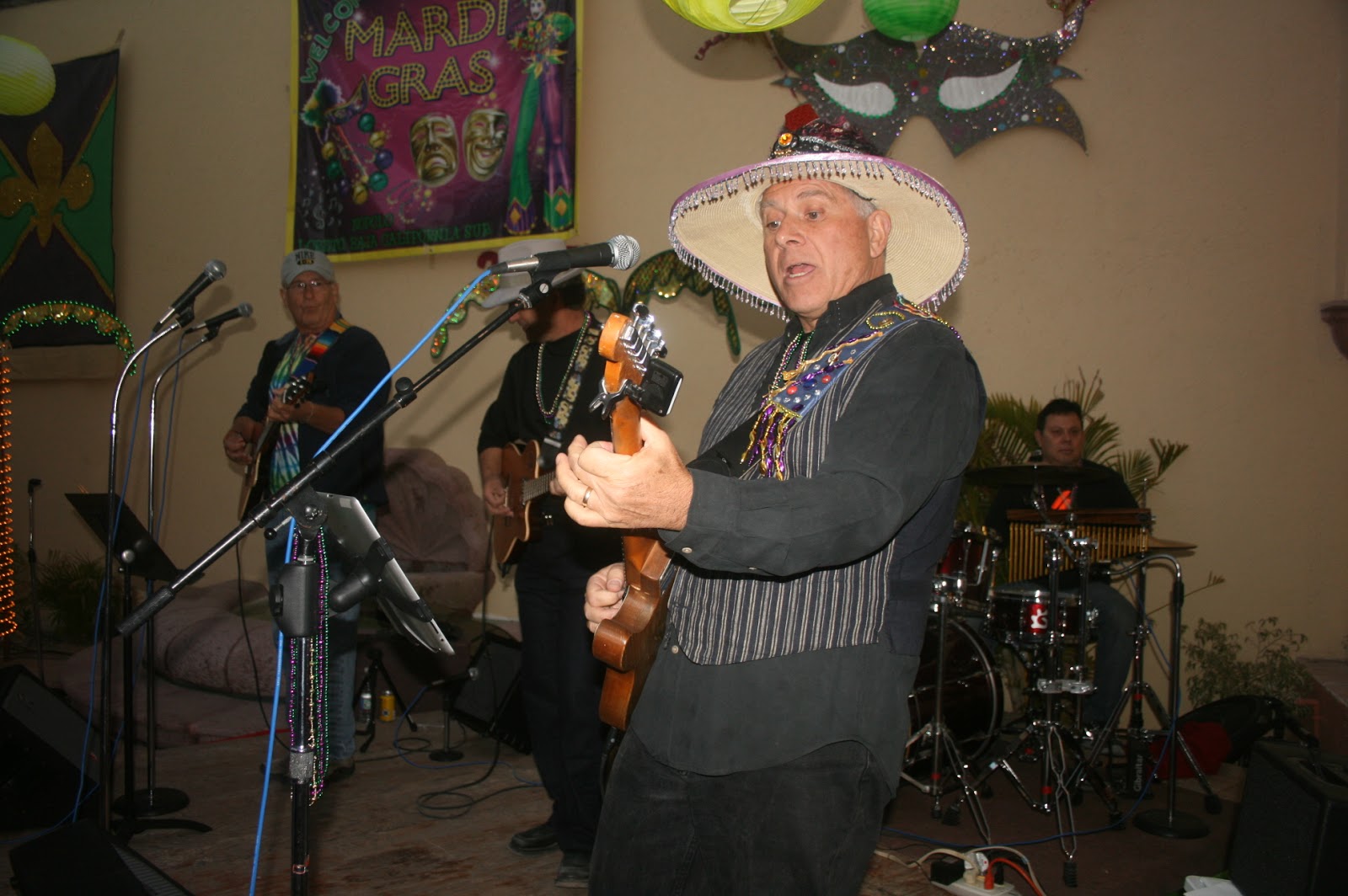
When most people had arrived the entertainment began, with a solo Flamenco dancer and a quartet of Mexican folk dancers providing a colorful start to the evening’s festivities.  They were soon followed by Los Beach Dogs – the ever popular house band for any noteworthy events in Loreto Bay.  This time the ‘Dogs were backed up by a local Loretano drummer who added the backbeat that got people up - and kept them dancing through the evening.
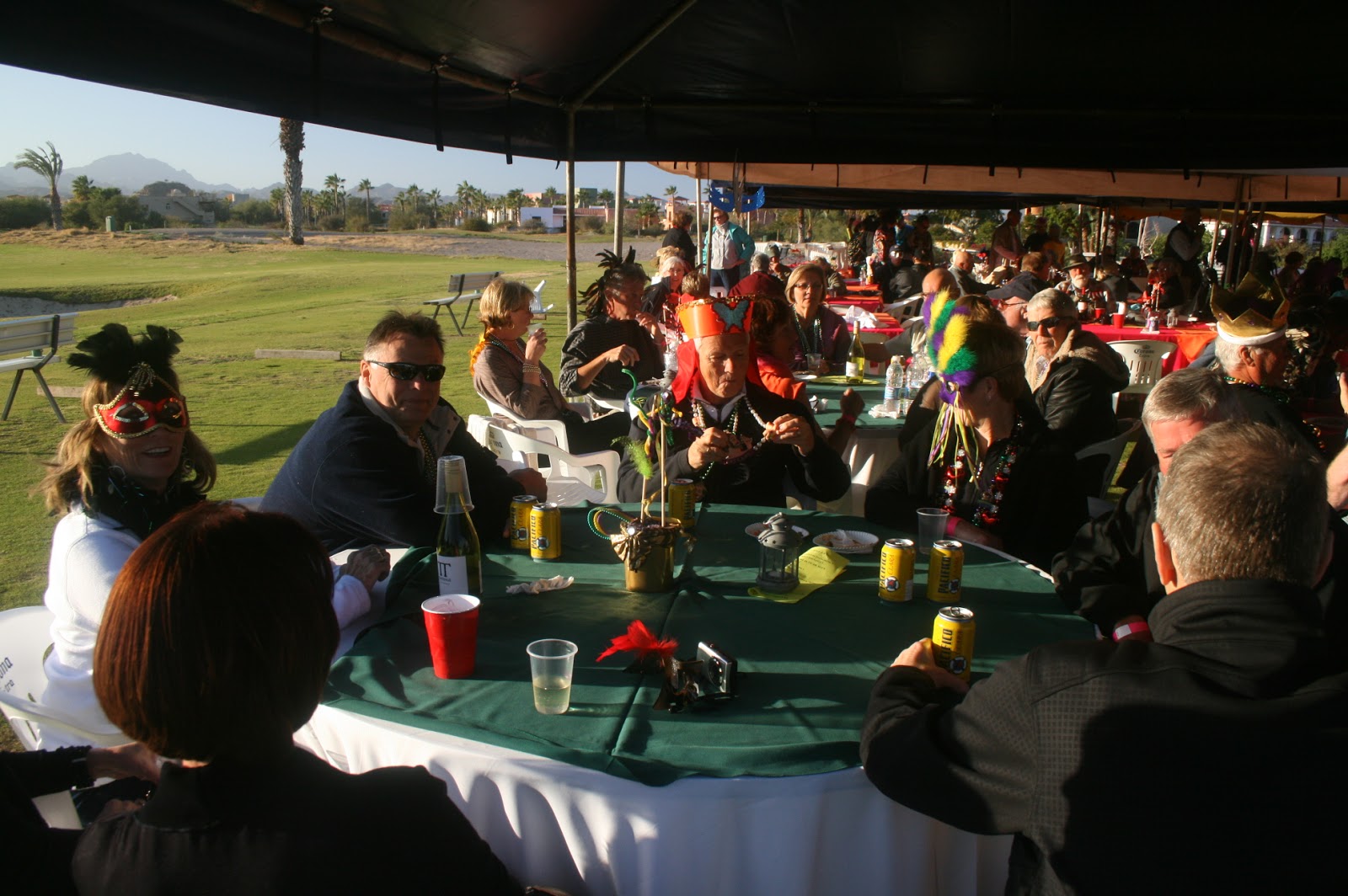


Those who were not indulging their “dance feet” (or watching those who were) on the Courtyard dance floor, found places at the tables under the tents where they could visit and socialize while enjoying watching the sunset a few drinks and nibbling on snacks and appetizers .  This was a great opportunity for people watching and appreciating the time and thought that had gone into some of the more amazing costumes.       

As it was beginning to get dark, and the gusty winds were thankfully subsiding, food began to be served and lines quickly formed – and kept moving steadily, no small feat when it comes to feeding over 200 people!  The band called a break to enjoy their own dinners, and soon most of the tables and chairs were full of people enjoying their delicious meals.  While we were eating, another singer took the stage and serenaded the crowd with Mariachi-style songs to a recorded back up and then moved outside with his cordless mike and put on a side show for the diners.


After the break for dinner the ‘Dogs retook the stage and kept the dance floor jammed for the rest of the evening, meanwhile people moved easily around the colonnade surrounding the courtyard – listening to the music, watching the dancers and enjoying each other’s costumes and conversations or moved outside to refresh their drinks at one of the bars – because, even though the wind wasn’t blowing, the Hurricanes were flowing (if you get my drift!).


As the evening wound down and it was getting close to “Baja Midnight” (anytime after about 9:00 pm here) Shelia once again took to the stage and announced a number of individual costume prizes for some of the most outstanding getups.  Along with these (that space and my faulty memory prevent me from fully listing here) I too was selected to win - for which I was most grateful, although the category of “funniest” men’s costume, left me a little confused – recognition in any form is always welcome!  Let’s face it, the opportunities for wearing my McNabb tartan kilt here in Mexico are few and far between, but I trust the category was not a comment about my knees!

And so, another celebration came to an end, and as I made the short walk back to my home that evening I was struck again by what a unique and special community we are building here – big enough to successfully stage a party like this for over 200 people, and yet small enough so that most of the people there - knew most of the people there!  People from Loreto Bay and the surrounding neighborhood, Loretanos and ex-pats from town, all coming together to share the spirit of celebration and many of them going to great lengths to plan ahead and bring a costume in their luggage, or make it from scratch – or pull something together with last minute inspiration.  Making their special contribution to the magical energy of a special evening of Carnival spirit – that is what makes it special “Living Loreto”!      

Sunday, February 10, 2013

The Dog Man of Loreto


This week I had the opportunity to meet a low key local hero – Patrick (who I call) “The Dog Man of Loreto” - when a friend took me to visit him at his animal shelter, which he has created on a side street in the town of Loreto.  Inside this compound there are about 20 or so dogs, most housed in open air kennels and the rest free to roam the open areas where there are improvised shade structures and storage containers.  

Patrick’s story in Loreto began about 10 years ago when he built his home here in Nopolo and later, when he retired from a law career in the US, he and his wife Monica came to live here fulltime.  As a dog lover, he soon had 4 or 5 rescued animals living with him and over time this led to friends and neighbors bringing him other injured or abandoned dogs they had found.

For Patrick, caring for these animals went beyond any first aid they might require and included spay or neutering them as well as vaccinations against the risks and hazards common to dogs in this environment.  When the dogs had received these treatments and had been restored to a healthy condition through good nutrition and care, the next challenge was to find good homes for them where they could continue to live in safe and caring surroundings. 

Over the years, many of these dogs have found homes in Loreto and a growing number with Homeowners in Loreto Bay, who have adopted a local dog that they take back and forth with them as they travel between their southern and northern homes.  When the supply of rehabilitated dogs exceeded the local demand for pets, Patrick would transport several of them north to the US where they would be “fostered” by other dog lovers until permanent homes could be found for them there.

Before I continue with Patrick’s story, for those of you not familiar with the realities of a “dog’s life” here in Mexico, some background may help put this into perspective.  Typically, many dogs in Mexico must fend for themselves, as part of an unwanted litter or after being abandoned by their original owner for any number of reasons.  The root of much of this problem is the widespread lack of spay and neutering - procedures that may be unaffordable to many average Mexicans, even when available.  This in turn leads to the uncontrolled population growth of stray animals, and in turn, more disease, injury and ultimately more uncared for animals.

This sad situation was also the case here in Loreto in the past, before the Loreto Bay Development began almost 10 years ago, with malnourished and/or injured animals not an uncommon sight in town and along the highway connecting the town with this Development.  With the increasing numbers of ex-pats choosing to make a home here (among whom were a significant number of dog lovers), one result was the creation of an organization called Animalandia, which conducts local spay and neuter clinics, made possible by volunteer vets (mainly from the US) and supported by local fundraising and volunteer support.  Over the years this has resulted in over 2,000 animals being “fixed” here, which has prevented who knows how many thousands of their prevented offspring from continuing the miserable cycle of suffering that would have been the case before.

Patrick’s approach has been different, as a private individual he chose to take on a personal responsibility to do what he could to rescue and rehabilitate many of the animals that he came upon, or were brought to him, that were trying to survive in desperate circumstances.  Typically, this commitment often first involved treating injuries or diseases, many sustained from being hit by cars or from attacks by other animals, then restoring their strength and vitality with good nutrition and vaccinations against disease and parasites, before eventually the animals were healthy enough to have the surgery that ended the downward reproductive cycle they had been rescued from.

This comprehensive approach towards the rehabilitation and eventual adoption of the dogs into safe homes where they would live healthy lives, would often involve months (and in some cases years) of care and hundreds of dollars of expenses for surgery, medications and food for each rescued animal – all of which Patrick quietly went about doing out of his own pocket.  Over time however, word of his good works spread among the growing numbers of dog loving ex-pats who were moving into the community and he began to get assistance from them in caring for the animals, often by just spending time walking the dogs and helping to socialize them to positive human contact.

Before too long, the demands of this private shelter activity overwhelmed the capacity of his home property in Nopolo and Patrick decided to move the whole operation into town, where he owned several undeveloped lots.  Starting with a simple perimeter fence, over time he added wire kennels and now the ongoing project includes several storage container boxes salvaged from trucks and even a small corral where a small burro and a blind pony are currently kept.  With this increased capacity, there is now the space for a couple of dozen animals to be cared for at a time, with a slow but steady turnover as the dogs regain health and new homes are found.

When there were not sufficient safe and healthy homes locally for the “graduates” of the shelter Patrick has slowly developed further options north of the border.  Most often this has involved putting together a group of 4 – 6 dogs, who have all been “fixed” and have been certified in good health by a vet, and then Patrick (or occasionally a volunteer) would make the long drive north with them to the border where they would import the dogs legally into the US. 

In addition to placing the dogs with individual foster homes, recently a relationship has been developed with a shelter in Portland OR (with the assistance of Kristen Winn) that will accept animals for adoption with a donation of $100 US per dog to support their placement work.  In the past, this has involved either driving the animals over 1,000 miles further north to Portland or arranging for them to travel by air direct from LA or San Diego to Portland - both of which options require considerable logistical and financial organization and support - which is now increasingly coming from a small but growing local network of volunteers and supporters. 

As our visit came to an end, Patrick made an emphatic point of acknowledging the support of the people in this community and elsewhere who are contributing their time and money to help him extend his good works to benefit the seemingly unlimited numbers of animals in distress.  One of the most important members in this network is Dr. Gabriel Meza Leon of La Paz, who is a gifted and generous veterinarian that does all of the work on Patrick’s rescue animals. 

He went on to mention by name more than half a dozen volunteers and supporters who assist regularly with the considerable daily care requirements of the sheltered dogs.  Others have transported animals either by car or by accompanying them on flights north, not to mention a growing number of adoptive owners here and further afield that provide loving and caring homes for these – the luckiest dogs in the Baja! 

Recently, these volunteers have also done some private fundraising to cover the donations to the Portland shelter, but Patrick continues to self-finance the rest of the operation, which over the years has provided a new lease on life for over 200 animals that would inevitably met a cruel end, had it not been for this canine’s Good Samaritan. 

For those of you who are in Loreto Bay and want to assist with this good cause by volunteering some time to walk dogs you can get in touch with Dee in FN 63 or Rich in FN105.  Rich will also accept cash donations, 100% of which will go towards the placement charges by the Portland shelter.  If any other readers are interested in contributing to this good cause checks made payable to TMRE with a note on the memo line “Segunda Chansa” (to direct the funds to assist with Patrick’s project) can be mailed to TMRE,  665 Tabor Lane, Santa Barbara, CA. 93108, US donors can get a charitable tax receipt.  There is also a website www.TMRE.org with more information.   

Learning about how the generosity and dedication of one man has saved the very lives of so many threatened animals – and touched those of so many more humans, whose lives in turn have been enriched through these adoptions – this has indeed been an important lesson for me in “Living Loreto”!

Sunday, February 3, 2013

Property Management in Loreto Bay


There was an important (if subtle) change in my lifestyle here in Loreto Bay effective at the beginning of this New Year.  For the first time since taking possession of my home over seven years ago I no longer have a Property Manager.  With over 600 occupied homes in the Development there now are about 10 Property Management companies operating here, down by almost half from several years ago – due mainly to survival of the fittest.

For most people here a Property Manager is an important part of owning a Loreto Bay home, since a large majority of the owners spend less than half the year in residence.  Although the menu of services offered varies from one company to another, one of the most important functions that they all provide is regular home inspections – because it is unadvisable to leave a home in this climate unattended for over half the year.

Regular home maintenance can also be provided by Property Managers, either “handyman” type services by their staff, or for more complicated work and renovations they can sub-contract with local trades, oversee the work, handle the payment for it, and finally billing of the Homeowners.   

Another basic service is landscape maintenance inside the home, since all Loreto Bay homes have some open areas inside the home, most have main floor courtyards with landscaping and often potted plants on the second floor terraces and some have private garden spaces as well.  Pruning and tidying these plants, as well as checking the irrigation system that waters them, is “in-home” maintenance that is the responsibility of each Homeowner, while the HOA maintains the extensive common area gardens and courtyards outside of the homes.

 A small, but not insignificant service is paying taxes and utility bills – something that cannot be done unless you are here “on the ground” in Loreto.  Property Taxes, payable to the town of Loreto, are low, by North American standards, and (because of chronic municipal budget shortfalls) there is usually a further discount available before the end of the calendar year for pre-payment of the next year’s taxes.  This practice has become common over the past number of years, and now that that pattern is established it is unlikely to change in the foreseeable future and Property Managers can take advantage of the discounts available by seeing their Client’s taxes are paid before the discount deadline.    

Utility bills are a different situation – and one that may be, I think, uniquely Mexican.  Electricity is billed every second month, after a “CFE” employee on bicycle reads the meter at every house in the development, followed a week or so later by the same employee delivering a paper bill which he tucks into the crack of the front door of the house – or delivers a batch of bills to the Property Manager for the homes they take care of.  If, however, this paper bill say, blows away, or is otherwise lost and the Owner or their Manager is unaware, the power can be cut off, without further notice, requiring a reconnection charge not to mention an inconvenient period of time without electricity.

Because I have been living here for more than six months annually for the past five years, it was probably time for me to take over the responsibility of managing my own home, which happened at the beginning of this year.  As luck would have it, just a few days shy of the New Year there was a water leak somewhere under the kitchen sink and when my Property Manager sent one of her staff to check it out they determined that the leak originated in the faucet and he could not repair it.  After managing with only hot water at the sink for a few days, on the first working day of the New Year, I left the house for my three minute bicycle commute to the Real Estate Office, and bumped into (figuratively speaking!) Rick, the “premier plumber” who works here in Loreto Bay.

Arrangements were made on the spot for him to make a service call at the end of that day, when he confirmed the leak was in the faucet and it had to be replaced not repaired.  Which, given our limited access here to such things as plumbing hardware, could have posed another problem.  Except that (thanks to Loreto’s apparent synchronicity) Rick just so happened to have a brand new, high end faucet he had replaced in a custom home (because it was the wrong plated finish) that he could let me have at his cost.  The following day he returned with this beautiful new faucet, which when installed, was a big improvement over my original one.

But this was not my first accomplishment in self-management.  Last winter I had become dissatisfied with the landscape maintenance services provided by my then Property Manager and so I opted out of that service and did my own maintenance of the courtyard plants and the upstairs pots.  This worked reasonably well while I was here, but I needed to make arrangements to keep the garden maintained when I was away over the summer months. 

That is when I spoke to Lenin, who I had gotten to know back in the “early days” of Loreto Bay when he worked for what was then the only landscape company working in the Development.  Over the years since, Lenin had pieced together his own small maintenance business doing gardens and some pools as well as other odd jobs in the development to subsidize his “main” job working at a restaurant outside of town.

It was there that I met him and first spoke to him (his English is self-taught, and superior to my Spanish) about taking care of my garden during the summer.  By the time I was ready to leave I had also contracted for him to repaint the exterior of my home after some plaster repairs were completed during the time that I was going to be away.  On my return this Fall I was pleased with the job he had done and he has continued to my maintenance ever since, including a big project late last year which involved digging up all the plants in my courtyard, reconditioning the soil and replanting a new collection of plants.

This past week I took another small step towards my “independence” – the first electricity bill of the New Year was due and so I took my aforementioned slip of paper into town and found the CFE Office, which I recalled having been to once before several years ago.  When I arrived at the small cement block building in the Zaragosa district of the town, I didn’t think much of the fact that there were no other cars in the small parking lot, but as I was getting out of the car I noticed that the office hours painted on the office door said that they closed at 2:30 – and it was then after 3:00.

Before I had the chance to gnash my teeth over the vagaries of Mexican business hours, a smiling uniformed security guard I hadn’t noticed before approached me and with our combined “Spanglish” he confirmed that I was there to pay a bill and gestured me through the unlocked door to a vestibule area inside where there was an ATM-type wall mounted machine.  With a little help from the guard I quickly figured out how to scan the bar code on the bill which brought up my account details on the small screen and after feeding the required bills into the machine it coughed up the change owing and printed a receipt – one of the most high-tech transactions I have experienced here in Loreto!

Reflecting on these events while I was driving back to Loreto Bay afterwards, I took some real satisfaction from this admittedly small accomplishment as being yet one more step towards my independence here.  By taking responsibility for handling the small day-to-day things that make up a real life here in my adopted community, that is another important part of “Living Loreto”.   

P.S. Due to the nature of this week’s Blog it didn’t lend itself to pictures, but as a special treat I am passing on the following link for a great new video that I was sent this week – just the thing for any of my readers stuck in the mid-winter blues up north – enjoy!   

Loreto Adventure Tourism 2013
 

Sunday, January 27, 2013

Paseo Tour in Loreto Bay


After doing the last couple of posts on subjects outside of Loreto Bay I thought this would be a good time to shift the focus onto some of the progress and developments within our community, because there continues to be a lot of work going on here.  So this week I took a bike ride along the Paseo that passes through Loreto Bay and I am reporting on some things that caught my eye.

Probably the most dramatic changes that have occurred during the past year have been in Agua Viva, the second and final phase of Loreto Bay to be developed.  Four years ago, when the original Developer had ceased operations there were few completed homes in this phase but over the next year or two over 100 homes were completed privately by the owners.  However, the common areas around the completed homes were not finished and there were gravel paths and no landscaping.

More recently that changed with flagstone paths, and later, landscaping being added by our HOA where there were clusters of finished homes.  Under a special assessment voted on by all the Homeowners in Loreto Bay work has continued during the past year on sidewalks along the Paseo and more recently beautiful landscaping is being added along these sidewalks.  Another major addition to Agua Viva in the last year is another Community Pool located towards the north end of the Development giving nearby neighbors more convenient access than the original Pool in the south end of the Founders Neighborhood.

Moving from Agua Viva to the north end of Founders one of the first things to catch my eye was the much improved façade of the “Hacienda” building with the tunnel leading from the Paseo into the first cluster of homes to be built in the Loreto Bay development.  This property, which has been standing unfinished for a number of years, was originally designed as mainly office and commercial space and is currently listed for sale.  Late last year the streetscape received a fresh coat of light grey paint with darker grey trim and much improved the appearance, now all we need is new ownership and investment to complete the building so it can assume it’s intended role in the community.

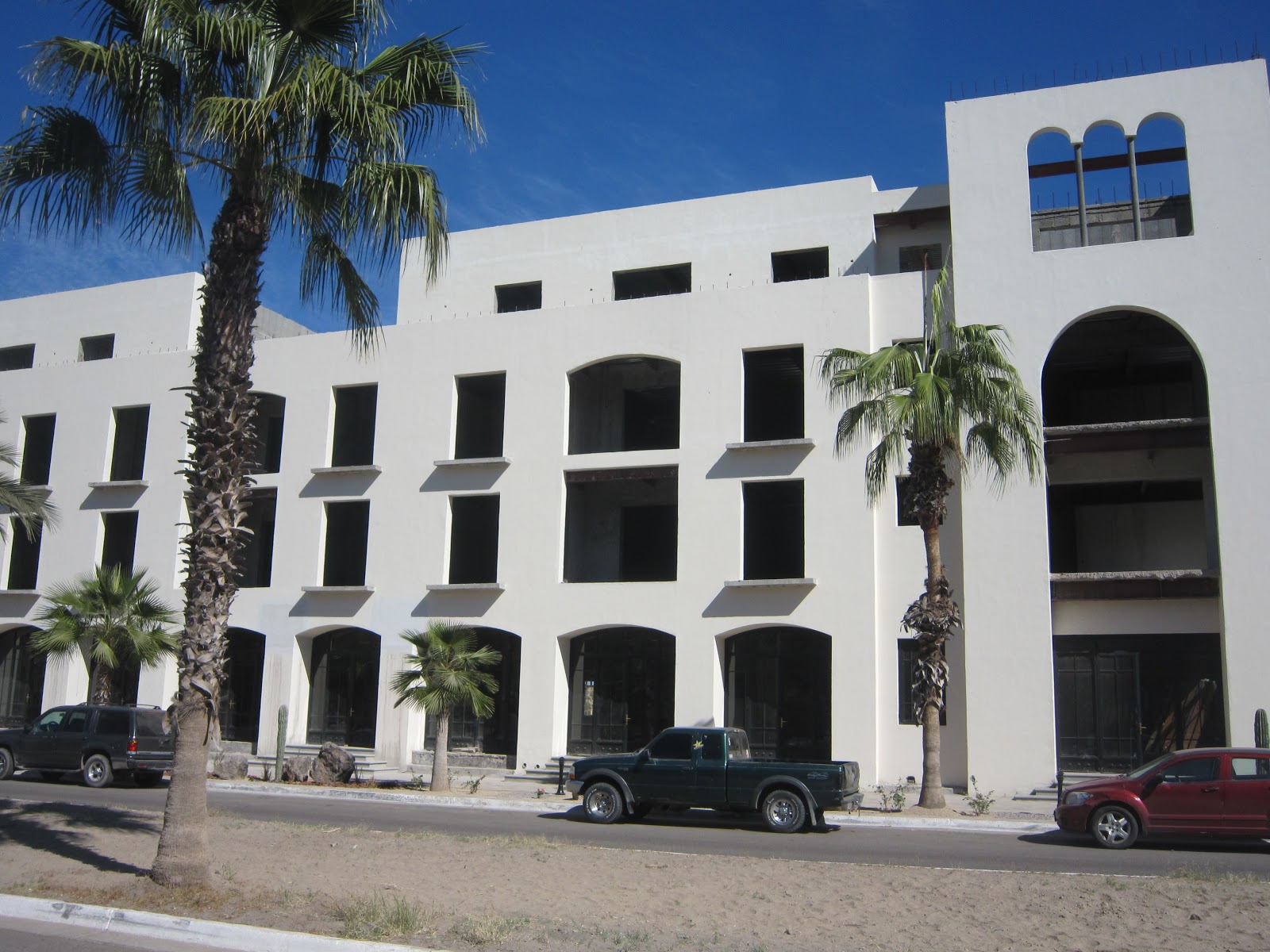
Next to the Hacienda building are two four storey buildings; Posada Norte and Sur which have their own history in the Loreto Bay Development.  These were designed as mixed use buildings with the main floors designated as commercial space and the upper three floors of each as residential apartment units.  Most of the apartments were sold a couple of years before the demise of the original Developer and the buildings stood partially complete for several years afterwards.  Homex purchased the main floors, along with several unsold apartments above as part of the liquidation of the assets of the original Developer, and last winter they finished most of the exteriors of both buildings which was a major improvement in their appearance.  This Fall they undertook some additional interior structural work on the Norte building, all of which encourages some optimism that we are getting near to a completion plan for both buildings, which has been under negotiation for the past year or more between Homex and the people who originally made deposits on most of the apartment units in the two buildings.

Across the Paseo from the Posada buildings one of the largest landscaping companies in Loreto Bay has set up an attractive and well organized garden Nursery to supply their own workers with the plant materials that are used in the common area landscaping, as well as work they do on interior gardens for Homeowners.  I purchased a number of plants there when I re-landscaped my interior courtyard just before Christmas and even picked up some poinsettias to enjoy inside my home over the Holidays.

More sidewalk landscaping is going on along the “commercial strip” of the Paseo in Founders where there are a number of retail and food services, some of which regular readers will recall my writing about in earlier posts.  I want to underline how much these improvements mean in the general beautification of our community.  Since the earliest days of Loreto Bay, the landscaping along the winding pathways has always been an important part of the ambiance as one walks through the clusters of completed homes, and over the years, as these plantings have grown and matured, the surroundings have become more and more beautiful.

But before this winter, and the progress of the two-year infrastructure program that we are halfway through, the beauty that could be found along the pathways and in Community Courtyards surrounding our homes off the Paseo was not seen by the casual observer driving through the Development.  But now, from the south access road around to the Inn, and through most of the length of the Community, the beautiful landscaping that has been so much a part of Loreto Bay is now being extended to it’s borders and making the streetscape a welcoming introduction to the garden-like surrounding found within.

Taken in total these changes have made the biggest improvement in the appearance of the development in the history of Loreto Bay, since most of the construction was completed in Founders neighborhood.  But, it is easy to take for granted the gradual incremental changes while they happen.  That is why it is important to occasionally stop and smell the bougainvillea, and appreciate the progress we have made so far, and, with a little imagination, see what this place will become.

Appreciating change when it happens, while keeping in mind the raw beauty of the natural surroundings and the amazing lifestyle that is being created here – that is the definition of “Living Loreto”!

P.S. I was sent the link below to the following article about kayaking in the Sea of Cortes including a number of references to Loreto that was published this weekend in the Calgary Herald newspaper - proof that I'm not the only one who thinks this place is special! 
http://www.calgaryherald.com/travel/Paradise+Cortez/7868342/story.html

Sunday, January 20, 2013

Have I got your attention yet?


The photographer that took this amazing picture, Richard Jackson, is the subject of this week’s Blog.  I have admired Rick’s breathtaking wildlife and landscape photography almost as long as I have lived here in Loreto when I started seeing his work displayed in some select locations in town.  Not long after that, I had the opportunity to meet Rick and his wife Jill, who are partners in a small “boutique” hotel just off the Malacon here in Loreto.

Recently, when our paths crossed again I asked Rick if he would be interested in being profiled in my Blog and you will be happy to learn he agreed – meeting with me in my Office in Loreto Bay this past week to tell me his Living Loreto story.


Rick’s Father-in-Law, who is an avid fisherman, had visited Loreto on frequent trips to the Baja over many years, and Jill and Rick were accompanying her parents on his retirement trip when they passed through Loreto in early 2004.  While walking the Malacon during that visit they wandered up a side street and saw a sign advertising a large residential compound for sale, consisting of a main home with 2 small “casitas” and a partially open boat garage with additional land for further development.

One thing led to another and before long Jill and Rick had become partners with her parents in the property which, after adding a couple of more casitas and a swimming pool, later that year became their new hotel, Las Cabanas de Loreto ( www.lascabanasdeloreto.com ).  When Jill and her parents returned to Loreto that fall to begin operating their new hotel, Rick carried on with his successfully established business travelling to art shows across the US, selling his prints of his wildlife photography.


Rick’s fascination with wildlife and photography had it’s beginnings watching “Wild Kingdom” every week with his Father when he was growing up, and carried on into Junior College where he took Zoology as the courses closest to his passion that he could find.  But, it was finally with the help of an Uncle that Rick was able to buy his first serious camera and lenses and set up a small darkroom, when he finally was able to pursue his passion for photographing nature and wildlife.

His career got off to an inauspicious beginning, at the first “swap meet” he attended as a vendor he failed to sell any of his early collection of wildlife pictures – but from that initial experience he quickly learned about the art shows that became a circuit that he worked diligently and with growing success over the next three decades. 

From that point on Rick and Jill’s life became an exotic blend of a “gypsy-like” tour of art shows, where he developed a clientele for his super realistic “once-in-a-lifetime” images of wildlife and landscape, alternated with field trips shared with Jill to distant locations like Africa and Antarctica where he restocked his collection of images, and almost as importantly the stories behind the images, that became his inventory for the art show tours.  In addition to the retail side of the business Rick has also had his work published in Audubon and Outdoor Magazine as well as Sierra Club books and posters.

Meanwhile, starting about 7 years ago with the opening of the hotel, Jill and his in-laws were living and working at building up the hotel business with growing success, particularly after achieving the coveted first place ranking for Loreto in Tripadvisor, which they have proudly maintained for a number of years.  Over much the same period of time as the hotel business was building, Rick was seeing a drop off in customers for his photography at the art shows due to the declining economic situation in the US and the reduced amount of disposable income generally.

As the numbers of art shows that he attended declined Rick began to shift his focus (no pun intended) more towards Loreto, where he found much to satisfy his appetite for natural history; perfectly situated as it is between the beautiful Sierra de la Gigante mountains, the Sea of Cortez and the collection of near-by islands, all of which provides him with more than enough inspiration and subject material to continue to grow his photographic collection.  He still maintains a striking website www.SoulCatchingImages.com where you can view and order his work and he still attends the occasional art show in the US, but now his and Jill’s life is centered here in Loreto.

But there is a new chapter about to begin for both of them here.  They will be opening a shared Office/Gallery on the town square in Loreto, where Jill will base her growing Real Estate business and Rick will be able to display his photographic art to visitors and residents of Loreto.  This exciting new enterprise will enable many more people to see the beauty and natural wonder that surrounds us here, through the gifted eyes of an artist of Rick’s caliber.

What started for me as a fascination with the stunning images I had seen (that make my photographs look like “snapshots”), and led me to approaching Rick about being a Blog subject, has given me a doorway into learning more about his and Jill’s life and what brought them to Loreto.  Now, with this understanding, I am even more impressed with the fact that this couple, who have travelled to some of the most spectacular places on earth to capture iconic images of natural beauty, have chosen to settle here and find the source of inspiration that all of us who are here understand – but few have the talent to express so memorably!  Truly in Rick’s art we can see a gifted vision of “Living Loreto”!  


This week I heard the sad news that a friend Alberto Perez had passed away suddenly.  I had gotten to know "Beto" on my occasional visits to El Caballo Blanco, the bookstore here in Loreto her ran with his wife Jeannine, and I mentioned him in a recent posting about a lecture held in the store "A Glimpse of Loreto's History, Nov. 2012". 
Although I did not know Beto well, I looked forward to visiting with him when I visited the store and will remember him sitting in a comfortable chair in the back room, talking about the books he loved that surrounded him there.
My condolences to Jeannine and his many friends in Loreto and beyond.
 

Sunday, January 13, 2013

Paulette - Loreto's Pie Lady


In my recent Blog describing Christmas dinner at Casablanca (my house here in Loreto Bay) I made reference to the pumpkin pie that we had for desert as coming from Ette’s Pies, which at the time gave me the idea that this establishment would be a good future Blog subject . . . well, the future is now!

I first got to know Paulette, the proprietress of said pie shop, when she was partners in a winning paella team at the inaugural competition held here several years ago.  Then just over a year ago she opened her Ette’s Pie Shop in the town of Loreto and I have been a fairly frequent customer ever since.  But I was curious about the story of how she came to be in the pie business here in our small town in the southern Baja, and so I arranged to meet her at the shop and find out more.

Paulette and her Husband first came to Loreto on a post-retirement RV trip through the Baja 17 years ago, and, like so many others ex-pats who have made their home here over the years, they fell in love with Loreto as one of the prettiest towns in the whole peninsula.  They soon had purchased an oceanfront lot on the north side of town and proceeded to build their dream home, an impressive 3 story structure.  In those days there were far fewer lodging options here than there are now, and not long after they were comfortably settled into their new home they started to receive unexpected visitors, knocking at their door inquiring if this was a Hotel?

After this had happened several more times Paulette decided that perhaps they were being sent a message and so she went about turning their home into a Bed & Breakfast, which quickly became very popular and for number of years operated on a more or less sold out basis most of the winter season.  Between her thriving business and her many social and charitable activities in the town, not to mention her passion for fishing in her custom designed Panga (that she employs a skipper for, so she can concentrate on the fishing) life was good - and busy.

However, like so many other businesses here in Loreto, things took a change for the worse after the winter of ‘08/’09 and the “perfect storm” of the economic crisis in the US, Swine Flu and too much negative press about Mexico, with the result that the B&B business dropped off dramatically.  However, Paulette kept busy, returning to the US to help run a friend’s restaurant business and wait for better times to return.

Back in Loreto during the summer of ’11, a planned weekend fishing expedition had to be postponed and so Paulette decided to take the opportunity to indulge one of her other passions and spent that whole Saturday in her kitchen baking pies – lots of pies!  The next morning early she set off to the Tianguis, or Sunday Market, and set up a booth selling her pies, whole and by the slice, to the largely Mexican clientele, since there are few “gringos” here during the heat of the summer.

It will come as no surprise now, to her many satisfied customers, that selling the pies at the Market were a great success and she sold out that first Sunday morning, and that initial success continued throughout the summer, building a delicious reputation among many of the local people.  (I digress for a moment, but for many of you reading this in northern climates, you will not appreciate the particular challenge of keeping cream pies and cheese cakes suitable for sale at an open air market on a simple folding table without refrigeration when the temperature is hitting 100 degrees with 80% humidity!  Paulette’s solution – she froze a 4” thick slab of ice in her biggest chafing dish and  fixed a cover over it so the pies stayed nicely chilled, displayed on ice, until the happy customers took them home to enjoy.)

Seeing the success of her summer market experiment, Paulette headed north to the US that Fall with a limited budget and a long shopping list of all the furniture, fixtures and kitchen equipment she needed to complete her meticulously planned new enterprise.  With extensive research, hours perusing Craig’s List and other sources and a generous helping of determination and creativity she bargained and even bartered for everything she needed to turn a previously somewhat shabby storefront on a main street in Loreto into the sparkling clean and warmly welcoming epitome of a Pie Shop.  (She proudly pointed out the custom cut lettering of her window sign with the matching professionally fabricated overhead sign outside and confided to me that she met a sign maker, who it turned out was an avid fisherman, and soon the deal was struck – he would supply her with her signage in exchange for an all expense paid week-long fishing vacation at her B&B in Loreto!)

Opening in time for US Thanksgiving (Pumpkin Pies!) a little over a year ago, the business took off quickly and with Sonya handling the front counter sales, Paulette soon added Norma as an assistant in the kitchen in back.  Homemade pies and deserts, cakes, muffins and even quiche and chicken pot pies were an almost instant success with the ex-pat community, hungry for familiar comfort foods and deserts for special occasions.  But, talking with Paulette, I understood that she takes particular pride in the growing acceptance and popularity of her baking with the local Mexican population – whose support, particularly through the long hot summer months when there are few other here, is vital to running a viable year-round business.            

I was allowed back into her small and spotless bakery kitchen that efficiently uses every square foot, and is stocked with every imaginable utensil and device necessary in a commercial operation, two Kitchenaid mixers, two Cuisineart processors, a domestic stove and a professional convection oven, two freezers and a fridge, and even a small storage trailer parked outside the back door for extra supplies.  “A place for everything, and everything in it’s place” could well be the motto over the door, and in the time I spent watching Paulette and Norma whip up a few more of their popular cheesecakes, it was clear that the whole set-up of the kitchen, and the shop itself, was geared to the efficient and professional production of a quality product – with a lot of love!

Getting to know a local character that has brought a rich and tasty new dimension to the enjoyment of food here in our town, while re-inventing herself and finding a business opportunity in a lifelong passion this is one of the most delicious parts of “Living Loreto”!

Sunday, January 6, 2013

San Javier redux - post Paul


I have had Visitors for the past couple of weeks, as regular readers will know, and this week I want to describe a trip I took them on - up to San Javier, a second Mission located about 32 km off the Highway between Loreto Bay and the town of Loreto.  I have written about earlier trips to this beautiful Mission building and the dramatic drive into the Sierra de la Gigante mountains to get there ("San Javier Revisited", November 2011) but this the first time my Guests had made the complete trip, as the road was closed partway due to construction on their previous visit.

It was also the first time I had made the trip since Hurricane Paul had channeled millions of gallons of runoff down the arroyos that have their source in this mountain range, and although I knew from various reports that the road was passable, I had heard that there had been some damage and was interested to see conditions for myself. 


The first part of the trip was uneventful with no apparent damage to the road, other than the odd stretch of broken pavement and a border of fallen rock and rubble that had washed down onto the roadside, where it ran beside steep banks or excavated cuts.   But after about 10 km (about 1/3 of the way from the Highway) we came to the first washed out part of the road, where almost the entire outside lane of the pavement appeared to have been “bitten” off and washed away down the bank.

Those of you familiar with this drive may recall that at about the halfway point there is a dramatic hairpin switchback on a steep incline, with the apex of the turn at the base of a long deep canyon that disappears up into the mountain range.  This was the location of the most dramatic evidence of the devastation that had been caused by the torrential runoff from Hurricane Paul. 


With the surrounding mountain peaks collecting many square miles of the accumulated rainfall, it was all funneled into this deep sharp canyon, with the resulting avalanche of water creating havoc as it crashed through this narrow V-shaped formation – carrying hundreds of tons of rock and rubble (some boulders the size and many times the weight of small cars).  The damage to the road began about halfway up the incline where the asphalt was stripped from the roadway and it became a pot-holed muddy track the remainder of the way up to the switchback corner. 

Approaching the corner, the rubble field from the runoff filled the gap between the roadway we were on and where it doubled back, continuing to climb the hillside.  Beyond the corner we returned to asphalt again, but after a short distance there was another huge bite out of the roadway, leaving only part of the inside lane remaining and 15 or 20 feet of 4  foot diameter drainage conduit hanging in mid air where the road has once cover it.

Making our way carefully around several of these damaged areas we were soon on smooth pavement again and carried on for about another 5 km before we came to the next eroded area where the road met the mouth of another canyon that had carried it’s own flood during the storm, followed by another patch carved away during the storm about another 3 or 4 km further on.  After we left the mountainous area and were on the high sierra the next 10 km or so of road was in perfect condition until we were about 4 km from San Javier when we encountered the final stretch damaged road.

This road on this final approach to San Javier had been all but destroyed by runoff and a detour had to be quickly upgraded to carry the many hundreds of pilgrims and visitors that descend upon this spiritual icon on it’s Saint’s Day, December 2nd, just weeks after the deluge that was Hurricane Paul.  Now, a month later, the new widened roadbed is being graded in preparation for repaving, but is once again passable to single lane traffic.

Considering the areas of havoc and devastation we had passed through to get there, the hamlet of San Javier itself appeared to be untouched by the effects of the recent storms and associated downpours.  And it should have been no surprise that the massive, rough hewn, stone edifice of the Mission itself was undisturbed, having been the spiritual center of this place for over 250 years, this building has withstood far greater challenges than the best that “Paul” could throw at it.

The rest of our visit followed much the same pattern as many previous ones; appreciating the rugged exterior stonework of the building and then stepping into the cool dusky interior of whitewashed plaster.  Walking between the simple wooden pews lining each side of the long narrow nave, where a modest crèche of plaster figures replaced several rows of the benches on one side.  Approaching the alter, the massive carved and gilded wooden screen that makes up the end wall of the transept, rises three or more stories overhead, decorated with oil portraits, (most of which have remarkably survived in the harsh climatic conditions) and the true majesty of the building and it’s antiquity reaches full impact.

Returning outside, we continue around the extended outbuildings and make our way back to the remains of the 300 year old olive grove, wandering along a pathway beside where the Jesuits created a primitive irrigation system.  Water, the secret to life in the desert, nourishing the first crops, from what had been barren desert ground, and eventually became a mainly self-sustaining settlement.  Surrounded by this living history and seeing it manifested in the simple farming practices that continue – still much unchanged today - creates a time-warp that blurs the distance between today and the 300 years of civilization that have contributed to the unmistakable spiritually charged atmosphere that permeates this hallowed place.

Reconnecting with a special place, through the act of introducing it to others - while appreciating the awesome fury of nature unleashed, and how fragile man’s infrastructure is standing against it, not bad for a half-day excursion when “Living Loreto”.
 
attraction